
Aluminum foam in the automotive industry
Aluminum foam is excellent at absorbing vibrations, impacts and blows, which makes it particularly suited to stiffness-critical and crash-relevant areas. In automotive engineering it could point the way for load-bearing structures in passenger cars and commercial vehicles: it performs more deformation work than pure steel profiles, so the material is impaired only after a very high degree of deformation. From this, Havel metal foam develops ready-to-install vehicle components, from the battery box for electric vehicles to underrun protection for trucks.
Updated:
Why is aluminum foam suited to crash-relevant areas of the vehicle?
Aluminum foam absorbs crash energy through plastic deformation: in a crash the material takes up large amounts of energy before it is impaired. Filling steel profiles with aluminum foam greatly improves their buckling and compression behavior while saving weight. Added to this are excellent vibration damping, for example against engine vibrations, and the recyclability of the purely metallic material.
The use of aluminum foam increases the torsional stiffness of the complete body by about 10 %.
- High energy absorption in a crash through plastic deformation
- Buckling and compression behavior of steel profiles is greatly improved
- Weight saving
- Excellent vibration damping, for example engine vibrations
- Torsional stiffness of the complete body increased by about 10 %
- Recyclability
Which vehicle components are built with aluminum foam?
Aluminum foam is used as a reinforcing element in the body area, wherever stiffness and crash behavior are needed together: in foamed bumpers, node areas and joints, in side impact protection, in door sills, in roof rails, side members and cross members, and in panel elements such as roof bows. Added to these are ready-to-install 3D shaped elements, such as crash absorbers and shaped elements for shock absorbers.
Documented application example: the aluminum foam crash absorber in the luggage net of a passenger car (3D shaped element).
- Foamed bumpers
- Node areas, joints
- Side impact protection
- Door sills
- Roof rails, side members, cross members
- Panel elements, for example roof bows
Why is the aluminum foam battery box suited to electric vehicles?
The battery box from the Havel Lite® series is made entirely of aluminum foam sandwiches. Low weight, good crash behavior, high bending stiffness and scope for temperature regulation make this newly developed component well suited to modern vehicle manufacturing. Webs in the form of aluminum foam sandwiches between the batteries act as spacers and crash absorbers; profiles or tubes can be integrated into the aluminum foam, for example for battery cooling. The housing is watertight, repairable, 100 % recyclable and provides good electromagnetic shielding.
Example element of aluminum foam: dimensions 975 mm × 536 mm × 55 mm, material thickness 4 mm; the crash behavior is shown to the standard DIN 50134, compression test of metallic cellular materials.
How has aluminum foam battery protection been tested and classified?
The energy absorption and good crash behavior of the battery box have been tested with a side crash test and a bollard test, the bollard test both in simulation and in physical tests. In the EVERSAFE project, an underbody impact was examined both in simulation and in physical tests: a vehicle with a mass of 943 kg drives at 40 km/h over a semicircular obstacle whose highest point lies above the lowest point of the battery box, so that driving over it subjects the housing to an impact load. The aluminum foam was developed further for the requirements of the Chinese standard GB 38031 (2020) and the European standard ECE 100; integrating fiber mats increases the fire protection. Both are standards that products are tested against, not certifications held by Havel metal foam.
Havel metal foam has carried out internal impact tests on aluminum foam sandwich panels developed specifically as a protective solution for batteries, with consistently positive results for stability and protective effect (benchmark: the Chinese standard GB 38031).
- Non-combustible
- DIN EN 45545-2: classified HL3 (material testing of AAS and SAS); no certificate was applied for.
- No toxic gases
- The build-up is purely metallic, with no plastics and no adhesives.
- Crash behavior
- Energy absorption and good crash behavior, tested with a side crash test and a bollard test, the bollard test both in simulation and in physical tests.
How does an aluminum foam battery box regulate the battery temperature?
With lithium-ion batteries in electric vehicles, three thermal limits have to be observed: below 0 °C the performance of the battery, and with it the range, drops considerably; above 30 °C aging increases sharply; above 40 °C irreversible damage can occur. Tubes and profiles can be integrated into the metal foam, making use of aluminum's good thermal conductivity: the internal cavities created in this way serve to route additional lines or to let media flow directly through to cool or heat the battery cells.
When the tube system is foamed directly into the metal foam core, a metallurgical bond to the cover sheets is possible; when it is inserted afterwards, the cover sheets are bonded to the metal foam with adhesive.
Which vehicle components has Havel metal foam built so far?
Fourteen components from Havel metal foam's own application catalog show where the material already sits in the vehicle: battery protection plates, base plates and cover plates, cooling plates and pack separators, foamed sills, floors for turntable ladders and articulated buses, a frame for hydrogen tanks and the rear underrun protection. Each card gives the build-up, the dimensions, the mass and the maturity, that is, whether the part is in series production, was built as a prototype or is a study. The range extends from series production of more than 3,500 units to a design draft; which manufacturer and which vehicle are behind it is not stated here.
Built and designed components for vehicles, from the Havel metal foam application catalogue.
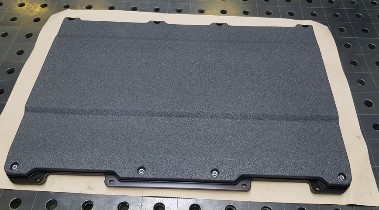
Battery protection plate
SeriesThe plate protects the battery of an electrically driven truck in a side impact, absorbing energy through the deformation of the foam core. It measures around 1,000 × 700 mm at about 30 kg and is foamed in the mould, given a heavy-duty coating and assembled in-house. Havel metal foam produces it in a series of more than 3,500 units.
Build-up: Aluminium foam sandwich with 3 mm cover layers
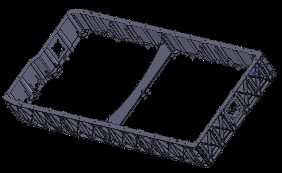
Battery frame
StudyA lightweight frame for the battery, redesigned for sandwich construction with aluminium cover layers. The design replaces the frame as a welded assembly with a single component of aluminium foam sandwich. It is at study stage.
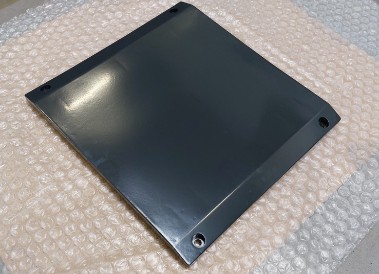
Crash element
PrototypeThe element sits at the side, in front of the battery of an electrically driven truck, and absorbs the impact energy before it reaches the cells. It measures around 650 × 600 mm at about 12.5 kg, is foamed in the mould and powder-coated. Havel metal foam has built it as a prototype.
Build-up: Aluminium foam sandwich with 2 mm cover layers
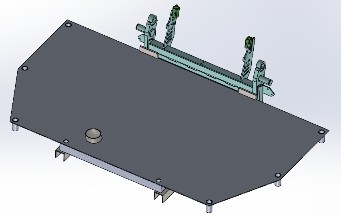
Turntable ladder floor
StudyThe floor replaces a complex welded assembly with a stiff component in one piece. Profiles, tubes and stiffeners are integrated into the sandwich, and the surface is slip-resistant. It measures 1,500 × 800 mm at an estimated 55 kg or so; it is at study stage.
Build-up: Semi-AAS with integrated profiles, tubes and stiffeners
Platform for articulated buses
The platform replaces a welded structure of several extruded aluminium profiles with a single component, which simplifies assembly. It measures around 1,600 × 1,900 mm at an estimated 55 kg; a slip-resistant surface is possible.
Build-up: Aluminium foam sandwich with aluminium cover layers, in one piece
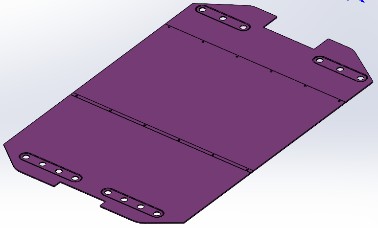
Battery cover plate
StudyThe cover plate closes off the top of the battery housing and is designed to be light and heat-resistant, with thermal runaway of individual cells in mind. It measures around 2,200 × 1,300 mm at an estimated 11 kg, made of about 7 mm of pure aluminium foam. It is at study stage.
Build-up: Pure aluminium foam, approx. 7 mm
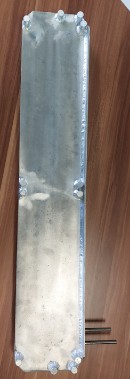
Cooling plate
PrototypeThe component does three jobs at once: it stiffens, it acts as a cross member and it cools the battery through embedded tubes. It measures around 85 × 150 × 12 mm. Havel metal foam has built it as a prototype.
Build-up: Aluminium foam sandwich with integrated cooling tubes
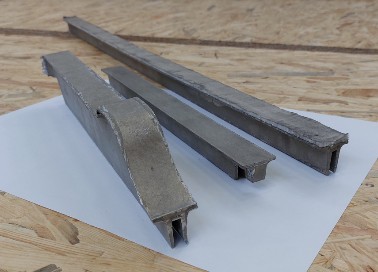
Pack separator
The separator divides the battery packs from one another, so that thermal runaway in one pack does not spread directly to the next. It is made of pure aluminium foam, foamed in the mould, 900 to 300 mm long, and a set weighs under 1,500 g. It is at pre-series stage.
Build-up: Pure aluminium foam, foamed in the mould
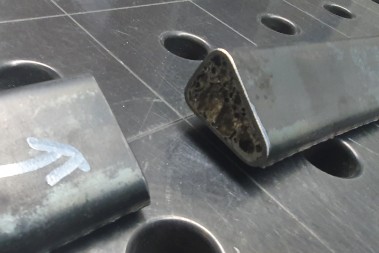
Foamed sill and rear member
PrototypeAluminium and steel profiles are filled with aluminium foam so that they absorb more energy in a crash. The filling sits in the existing cavity, and the geometry of the profile stays the same. Havel metal foam has built sills and rear members as prototypes.
Build-up: Aluminium and steel profiles with foam filling
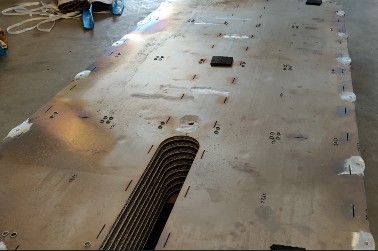
Battery base plate, light truck
SeriesThe cell packs sit directly on this base plate, which is therefore both the carrier and the floor of the housing. It measures around 2,800 × 1,300 mm at 70 kg, is laser-cut and carries welded-in inserts. Havel metal foam produces it in small series.
Build-up: AAS 20-2-2
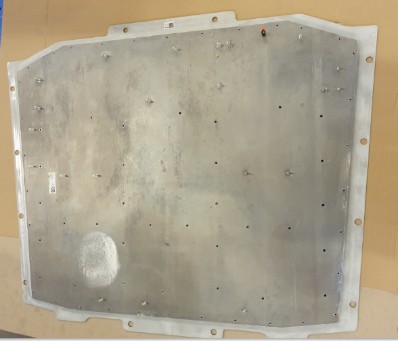
Battery base plate, light vehicle
Battery packs and electronics are mounted directly on the plate. It is foamed in the mould, so only the threaded holes still need to be made, and it is completed with blind rivet nuts and bolts. It measures around 1,100 × 900 mm at about 15 kg.
Build-up: Aluminium foam sandwich with asymmetric cover layers, 1.5 mm and 2.5 mm
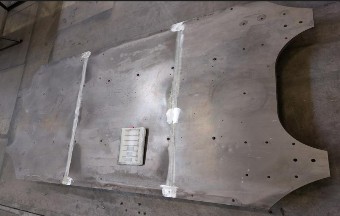
Base plate for a special vehicle
The base plate of an electric special vehicle is made from three welded sandwich segments; the outer contour and openings are milled. Solid aluminium inserts are embedded in the foam for stiffness and threads. It measures around 2,900 × 1,500 mm at about 80 kg.
Build-up: Three welded AAS segments with embedded aluminium inserts
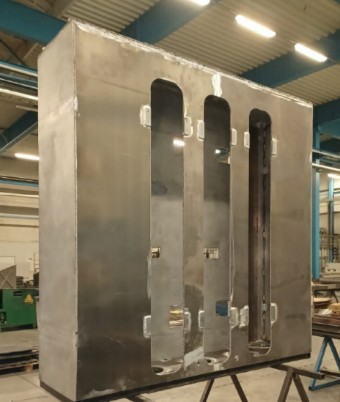
Frame for hydrogen tanks
The frame carries and protects the hydrogen tanks of a truck. Its stiffness comes from shell construction in aluminium foam sandwich, made as a welded assembly. It measures around 2,500 × 700 × 3,000 mm and weighs about 500 kg including the attachment points to the vehicle.
Build-up: AAS shell structure, welded assembly
Rear underrun protection for heavy trucks
A steel profile with a foam insert, designed for the requirements of UN ECE R58/03 and flexibly adaptable to different vehicle frames. The profile itself weighs around 30 kg without the mounting bracket. The build-up, testing and type approval of the series product are on the product page.
Build-up: Steel profile with aluminium foam insert
14 of 14 shown
Without clients: which vehicle and which manufacturer are behind a component is not stated here. Where no maturity is given, the catalogue gives none. Dimensions and masses are catalogue values, not drawing dimensions.
How does aluminum foam meet the new requirements for truck underrun protection?
The responsible body of the United Nations Economic Commission for Europe (UNECE) adopted the 03 series of amendments to UNECE Regulation No. 58 for underrun protection devices: underrun protection for trucks must now not only have different geometric properties from before, but must also withstand test forces almost twice as high in a strength test, for all vehicles placed on the market from September 2021 at the latest. The requirements were tightened above all for heavy commercial vehicles (N2, N3, O3, O4). Foaming the relevant profiles with a metallurgical bond leads to an enormous increase in stiffness and strength and to higher energy absorption on impact; the 3D foam parts can be pushed into existing underrun protection profiles, so that these also meet the new requirements.
Crash and structure
How does a foamed profile behave in a crash?
Also asked: What does the foam filling achieve in a crash? · Why does a filled profile crack later?
A profile from Havel metal foam filled with aluminum foam performs more deformation work than a pure steel profile, so the material is impaired only after a very high degree of deformation. In steel profiles the filling also clearly improves the buckling and compression behavior. For design, this means that energy is dissipated over a longer deformation path rather than through a crack: the absorber is designed for the load case, not for a strength limit.
- Sources
- Brand content
How much does the torsional stiffness of the body increase?
Also asked: By how much does the body become stiffer? · What effect does the foam have on the complete body?
With Havel metal foam, the torsional stiffness of the body as a whole rises by about 10 %. The figure is an approximation: we do not state on which vehicle or body-in-white it was measured, and we agree the corresponding test set-up in the project. As an order of magnitude for a preselection the value is useful; as proof for a specific vehicle it is not. If you need it for that, you can request the measurement basis with an inquiry.
- Sources
- Brand content
Has the underbody protection been tested against stone chipping?
Also asked: Does the underbody withstand an impact? · Which intrusion test was run?
Yes. For the underbody protection, Havel metal foam ran an intrusion test: a steel projectile 20 mm in diameter and 40 mm long at 240 km/h, that is 66.6 m/s, with the criterion of no crack on the rear face. The criterion was met. The test covers stone chipping and foreign objects from the road and is not a ballistic record; it must not be read as one. We give no details of the test laboratory or date here.
- Sources
- Brand content
New fields of application
Is there a solution for exhaust and noise protection at the silencer?
Also asked: What does the heat shield achieve? · How is the surface temperature limited?
Yes, as a design. Havel metal foam is working on a heat and noise shield for the silencer, prompted by Euro 7 and NNR3, with the design target of a surface temperature below 80 °C and, in addition, a noise reduction. The simulation shows sufficiently cool surfaces with acceptable hotspots and a greater noise reduction than a comparable solution. These results come from the calculation; the next step is validation on a prototype. The shield is not yet available as a tested component.
- Sources
- Brand content
Is the material also used on hydrogen tanks?
Also asked: Are there protective solutions for hydrogen storage? · What does UNECE R134 say about it?
Yes. The protection of hydrogen tanks against fire, explosion and vibration is one of Havel metal foam's fields of application, designed to the requirements of UNECE R134. The distinction matters: here the regulation is the design basis, not an approval that has been granted. We expressly do not claim approval to R134, and we give no details of any test here. For this load case the material brings together three properties that otherwise have to be addressed separately: non-flammability, energy absorption and vibration damping.
- Sources
- Brand content
Maturity and standards
Is there a development project with a vehicle manufacturer?
Also asked: How far has the application on the battery box progressed? · Are there demonstrators in the automotive industry?
Yes. Havel metal foam is running an exploratory project for a customer at TRL 3 to 4, which covers the frame of a battery box, a pole crash test on a demonstrator with an extruded aluminum side member, and two solutions for battery cooling. TRL 3 to 4 means feasibility in the laboratory and on the demonstrator, not release for series production. Who is involved is not stated; the details of the component itself are on the product page for the battery box.
- Sources
- Brand content
What role do the battery standards GB 38031 and ECE 100 play?
Also asked: Is the material certified to GB 38031? · Which standards apply to traction batteries?
They are standards that ongoing projects at Havel metal foam are working towards, not certifications of the material. GB 38031 is the Chinese standard for traction batteries, updated in 2025, and contains mechanical as well as thermal load cases; ECE 100 is the European counterpart. A material is not certified to either of them; what is tested is always the battery system. What aluminum foam contributes is energy absorption in the load case and a purely metallic, non-combustible build-up.
- Sources
- Brand content
Does Havel metal foam make vehicle parts in series production or only as samples?
Also asked: Are aluminum foam components in series production in vehicles? · How many units of a vehicle part does Havel metal foam make?
In series production. Havel metal foam makes the side-impact battery protection plate in a series of more than 3,500 units: an aluminum foam sandwich with 3 mm cover layers, around 1,000 × 700 mm, about 30 kg, foamed to shape, coated and assembled in-house. Alongside it are a battery base plate in small-batch production, cell separators in a pilot series, and a crash element, a cooling plate and foamed sills as prototypes. For an inquiry, this distinction is the real information: a component in series production is a solved manufacturing problem, a prototype is proven feasibility, a design is a calculation.
- Sources
- Brand content
Aluminum foam for your vehicle project
Straight to our specialist team, without going through sales.
- Prompt reply
- No account needed
- Your data stays confidential