
Battery box made of metal foam
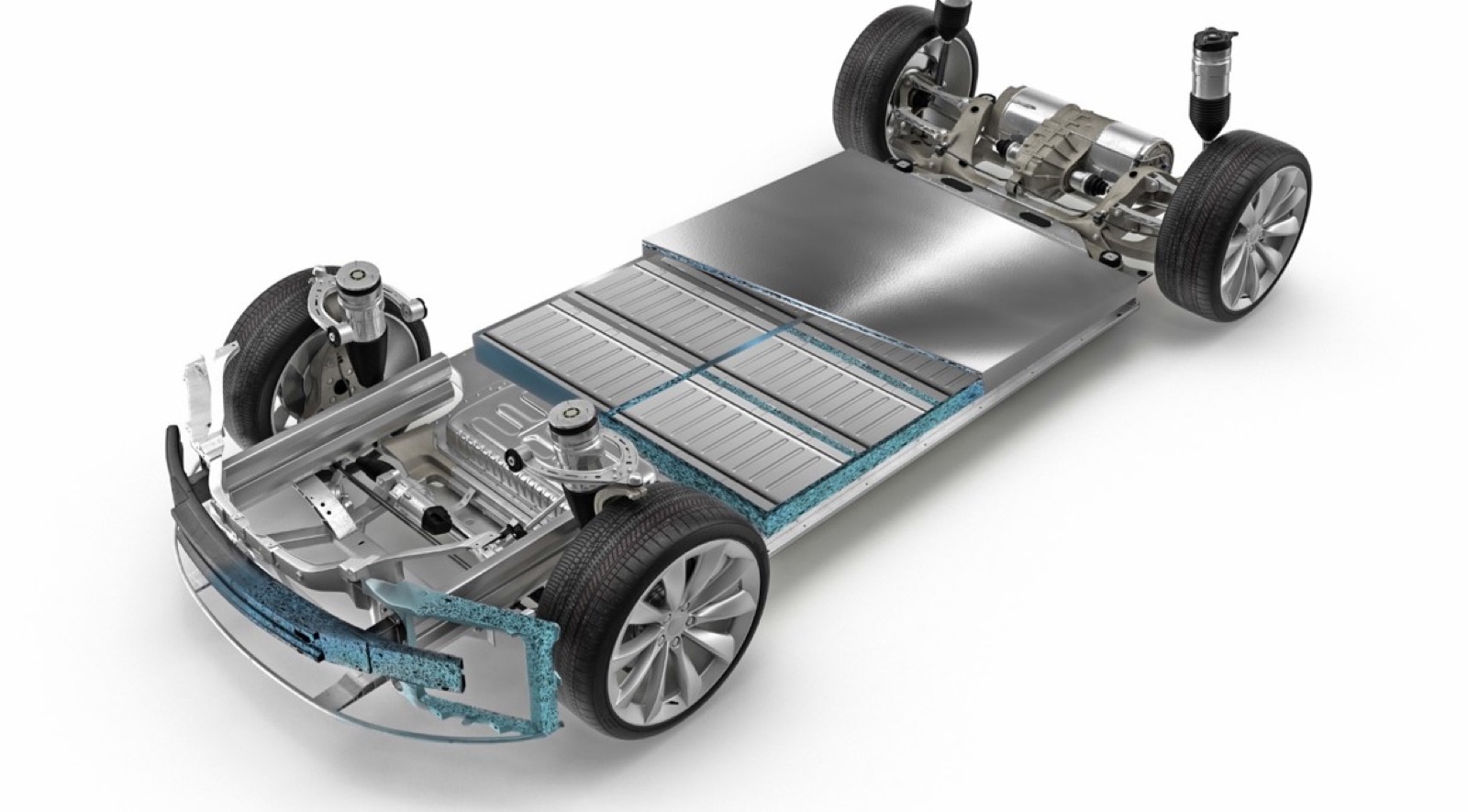
The battery box of the Havel Lite® series is a vehicle component for electric vehicles and is made entirely of aluminum foam sandwiches. Low weight, good crash behavior, high stiffness and options for temperature regulation make this newly developed component well suited to use in electric vehicles. The dimensions follow the customer's specification; from drawing to series production, everything is done under one roof.
Updated:
Why aluminum foam sandwiches for a battery box?
Aluminum foam combines extreme lightness, formability, recyclability and excellent absorption and conductivity, and these versatile properties make it ideally suited to enclosing batteries in the automotive industry. Partitions of aluminum foam sandwiches between the battery cells act as spacers and crash absorbers. Profiles or pipes for battery cooling can also be integrated into the aluminum foam.
Crash behavior (crash absorption) is described according to the DIN 50134 standard, the compression test for metallic cellular materials; a manufactured sample component of aluminum foam measures 975 × 536 × 55 mm with a material thickness of 4 mm.
How is the cooling system integrated into the metal foam?
There are two manufacturing technologies for integrating a pipe system into the metal foam core: direct foaming and subsequent insertion. In direct foaming, the pipe system is foamed into the metal foam core, so the cover sheets can be bonded metallurgically. In subsequent insertion, the pipe system is inserted into the metal foam core afterwards; the cover sheets are then bonded to the metal foam with adhesive.
- Direct foaming
- The pipe system is foamed directly into the metal foam core. The cover sheets can therefore be bonded metallurgically.
- Subsequent insertion
- The pipe system is inserted into the metal foam core afterwards. The cover sheets are subsequently bonded to the metal foam with adhesive.
How was the crash protection of the battery box tested?
Current electric vehicles mostly carry their safety-relevant battery technology in the vehicle underbody, so protecting the battery modules against a crash load from below is a very high priority. One of the new protective solutions is to protect the battery cells with aluminum foam sandwiches with aluminum cover layers (AAS). The EVERSAFE project investigated the underbody impact both in simulation and in physical tests: a vehicle with a mass of 943 kg travels at a speed of 40 km/h over a semicircular obstacle whose highest point lies above the lowest point of the battery box; driving over it produces an impact load on the housing.
Energy absorption and crash behavior were also tested with a side crash test and a bollard test, the bollard test both in simulation and in physical tests.
How does the battery box regulate the temperature of the cells?
When lithium-ion batteries are used in electric vehicles, three thermal limits have to be considered: below 0 °C performance and range drop significantly, above 30 °C the aging of the battery increases sharply, and above 40 °C irreversible damage can occur. Havel metal foam's manufacturing technologies allow pipes and profiles to be integrated into the metal foam, making use of aluminum's good thermal conductivity: the resulting internal cavities can carry additional lines or let media flow through directly to cool or heat the battery cells.
- At temperatures below 0 °C, the performance of the battery, and with it the range, drops significantly.
- At temperatures above 30 °C, the aging of the battery increases sharply.
- At temperatures above 40 °C, irreversible damage to the battery can occur.
How is the battery box designed?
The dimensions of the battery box follow the customer's specification. The base plate is made as a continuous sandwich to meet the leak-tightness requirement. The housing walls can be produced integrally or differentially: in integral production they are formed by wedge-shaped or rectangular recesses, with fewer joints and sealing provided by a closed outer cover layer. In differential production the housing is assembled from a large number of individual components, joined by welding or adhesive bonding.
- Integral production
- Housing walls formed by wedge-shaped or rectangular recesses: fewer joints, sealing provided by a closed outer cover layer.
- Differential production
- Housing made of a large number of individual components, joined to one another by welding or adhesive bonding.
What are the advantages of a battery box made of metal foam?
The battery box made of metal foam combines low weight with safety and function: it is non-combustible, gives off no toxic gases, is waterproof and 100 % recyclable; material testing of AAS and SAS to DIN EN 45545-2 resulted in classification as HL3, and no certificate was applied for. Foamed-in pipes and the high thermal conductivity make an efficient heating and cooling system possible; the purely metallic bond needs no adhesives.
- low weight; components can be foamed in
- foamed-in pipes and high thermal conductivity make an efficient heating and cooling system possible
- non-combustible (DIN EN 45545-2: classified HL3); no toxic gases
- waterproof; energy absorption and good crash behavior (tested with a side crash test and a bollard test, the bollard test both in simulation and in physical tests)
- absorption of oscillations, shocks, vibrations and noise
- simple mechanical processing possible (drilling, sawing, milling, welding); repairable
- different alloys possible; purely metallic bond; 100 % recyclable
- good electromagnetic shielding
Design and cooling
How is the battery box constructed?
Also asked: What is the battery box made of? · How is leak-tightness achieved?
The battery box from Havel metal foam is made entirely of aluminum foam sandwiches; the external dimensions follow the customer's specification. The base plate is a continuous sandwich, because strength and leak-tightness are required together on this surface. The walls are made either integrally, with wedge-shaped or rectangular recesses and a closed outer skin, or differentially from many individual parts. Sandwich webs between the cells act both as spacers and as crash absorbers. The housing was developed together with the Fraunhofer Institute for Machine Tools and Forming Technology IWU.
- Sources
- Brand content
How is cooling integrated into the housing?
Also asked: Can cooling pipes be foamed in? · Is adhesive used for the cooling?
Havel metal foam offers two routes, and they differ at exactly one point. Direct means the pipe system is foamed into the foam core during foaming; the metallic bond of the cover layers remains possible, so the composite stays free of adhesive. Subsequent means the pipe system is laid into a machined core and the cover plates are then bonded on with adhesive. This route is one of the two exceptions to adhesive-free construction. Depending on the core thickness, the cavities can carry additional conduits or let media flow through directly.
- Sources
- Brand content
Which temperature limits apply to the cells?
Also asked: Why does the battery need thermal management? · Is the housing leak-tight?
Havel metal foam works from three thresholds for the cells: below 0 °C the range drops significantly, above 30 °C aging increases sharply, and above 40 °C irreversible damage can occur. The housing therefore has to keep the cells within a narrow window, which is why thermal conductivity and integrated cooling count for more here than in other components. In a 3D-shaped version the material is helium-tight up to 10 bar; for solid-state batteries, densities around 0.7 g/cm³ and 3D formability are further suitable properties.
- Sources
- Brand content
Impact trials
How much deformation reaches the battery side in an underbody impact?
Also asked: What did the intrusion trial show? · How was the underbody impact investigated?
Havel metal foam investigated the battery box for this in the EVERSAFE project, both in simulation and in physical tests: a vehicle of 943 kg drove at 40 km/h over a semicircular obstacle whose top edge lay above the lowest point of the housing. With AAS 22 the impact side deformed by 15.7 mm, the battery side by only 2.3 mm, with a core compression of 13.4 mm. With AAS 28 the figures are 14.6 mm, 1.6 mm and 13.0 mm. The core therefore takes up the deformation instead of passing it through.
- Sources
- Brand content
What did the bollard test show?
Also asked: What effect does the sandwich thickness have? · Which standard is used to assess compressive behavior?
In the bollard test of the same EVERSAFE series by Havel metal foam, both in simulation and in physical tests, with AAS 15 the impact side deformed by 18.3 mm and the battery side by 10.0 mm, with a compression of 8.3 mm. With AAS 28 the figures are 23.7 mm, 7.8 mm and 15.9 mm. The thicker sandwich therefore compresses almost twice as much and lets less through, which is the design rule for this component: protection comes from the deformation path, not from stiffness. The basis for assessing compressive behavior is DIN 50134, the compression test of metallic cellular materials.
- Sources
- Brand content
Components and maturity
Which components are there, and how far have they been developed?
Also asked: Is this series production or a study? · Which parts are available?
Havel metal foam assigns the components to stages. The battery protection plate against side impact is in series production, with more than 3,500 units: aluminum foam sandwich with 3 mm cover layers, around 1,000 × 700 mm and about 30 kg. The battery base plate for light commercial vehicles is in small-batch production: AAS 20-2-2, about 2,800 × 1,300 mm, 70 kg, laser cut with welded-in inserts; a second base plate for a light vehicle measures around 1,100 × 900 mm at about 15 kg and has asymmetric cover layers of 1.5 and 2.5 mm. The cell separators of pure aluminum foam are in pre-series production: foamed in a mold, 300 to 900 mm long and under 1,500 g per set. The lateral crash elements are at prototype stage: foamed in a mold, about 650 × 600 mm and around 12.5 kg. Listed as studies are the battery lid, with about 7 mm of pure foam and around 11 kg, and the housing frame.
- Sources
- Brand content
Is there also a housing for stationary energy storage?
Also asked: Is the material used for battery storage? · What protects in the event of a cell failure?
Yes. Havel metal foam offers a housing for stationary energy storage made of SAS 20-2-2, that is, with only 4 mm of steel in the cover layers, designed for explosion protection and fire protection in case lithium-ion cells fail. It is therefore a different product from the vehicle housing, with a different load case: in stationary storage the issue is not impact but controlling a cell failure in operation. For this, the material brings non-flammability and energy absorption together in one component.
- Sources
- Brand content
Project inquiry in 2 minutes, straight to the specialist team
From specification to series production, without going through sales.
- Prompt reply
- No account needed
- Your data stays confidential