
Aluminum foam in mechanical engineering
In mechanical engineering, lightweight composite materials allow a considerable reduction in the weight of the masses to be moved. For moving assemblies, lower mass and high vibration damping are a great advantage: smaller drives and designing for lower forces become possible.
Updated:
What are the advantages of aluminum foam in moving assemblies?
High-damping lightweight composites bring four core advantages, depending on the specific application: extremely lightweight construction, higher machining accuracy, higher machining speed and a longer service life. The lower moving mass allows smaller drives and designing for lower forces.
- Extremely lightweight construction
- Higher machining accuracy
- Higher machining speed
- Longer service life
In which mechanical engineering applications is aluminum foam used?
The areas of application cover conventional machine tool construction as well as highly dynamic processes: from laser applications through solar module, electronics, micro and optics production to packaging machines, woodworking, handling and assembly technology, food processing and pick & place applications, wherever masses have to be moved quickly and precisely.
- Machine tools
- Laser applications
- Solar module production
- Electronics production
- Micro production
- Packaging machines
- Woodworking
- Handling and assembly technology
- Optics production
- Food technology
- Pick & place applications
Which aluminum foam machine components are documented?
Three documented component examples show the range: a support beam for the spools of a textile machine, in which the foam core is encased in cast aluminum; an intermediate flange of a gear-cutting machine with a glued-in metal foam ring; and the cross gantry of a milling machine. In every case the structures are moving or subject to vibration, where low mass and high damping come together.
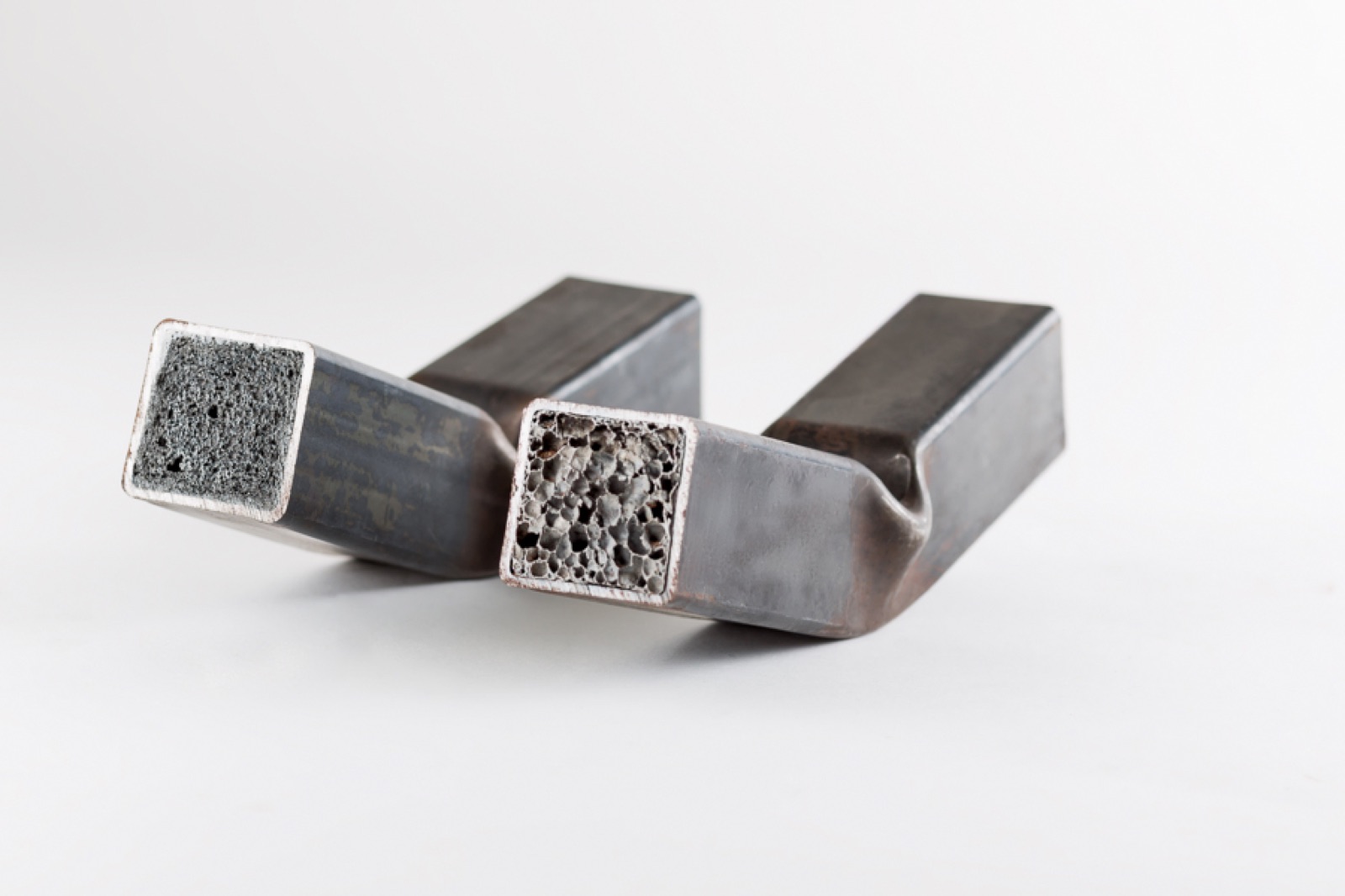
- Support beam for the spools of a textile machine: foam core encased in cast aluminum
- Intermediate flange of a gear-cutting machine: with a glued-in metal foam ring
- Cross gantry of a milling machine
What does aluminum foam do for ergonomics and machine service life?
Lighter components mean less physical strain and easier handling, a clear advantage in production environments where efficiency and ergonomics matter equally. At the same time, aluminum foam absorbs vibration and impact particularly well, which reduces machine wear and extends machine service life. Havel metal foam also supports one-off production and very small series.
Weight and damping
What does the weight saving with aluminum foam bring in mechanical engineering?
Also asked: Why does the moving mass of an assembly matter? · What does lightweight construction achieve in mechanical engineering?
With high-damping lightweight composites, Havel metal foam reduces the mass of the assemblies to be moved in mechanical engineering. The advantage counts most in fast-moving assemblies: less moving mass means lower acceleration forces, and that is the reason the material is considered for milling gantries, beams and foundations in the first place.
- Sources
- Brand content
How strongly does aluminum foam damp vibration?
Also asked: How was the damping measured? · How good is the vibration damping of metal foam?
The damping effect of Havel metal foam's aluminum foam was measured by the Fraunhofer Institute for Machine Tools and Forming Technology IWU, on steel profiles suspended from two wires and struck with a hammer. The recorded result is an increase in damping of 500 to 600 % compared with the unfilled profile. The test set-up is deliberately simple; it compares the same profile with and without a foam filling.
- Sources
- Brand content
Why does aluminum foam improve machining accuracy?
Also asked: How does the damping affect cutting? · Does aluminum foam allow higher cutting speeds?
The reason lies in the combination of low mass and high vibration damping: Havel metal foam cites both as the precondition for higher machining accuracy and higher machining speed. What is documented is the damping itself, measured as an increase of 500 to 600 %; there is no measurement of the machining result. For a specific machine, the effect therefore has to be determined by test or by calculation.
- Sources
- Brand content
Components and applications
Which machine components are made from aluminum foam?
Also asked: What is metal foam used for in mechanical engineering? · Which components are suitable?
Havel metal foam has made three components: a support beam for the spools of a textile machine, in which the foam core is encased in cast aluminum; an intermediate flange for a gear-cutting machine with a glued-in metal foam ring; and the cross gantry of a milling machine. In addition there are base plates of machine foundations for vibration damping. The intermediate flange is one of two documented cases, across all applications of the material, in which adhesive is used.
- Sources
- Brand content
In which areas of mechanical engineering is the material used?
Also asked: Which sectors of mechanical engineering is aluminum foam suited to?
Havel metal foam covers a wide field of applications in mechanical engineering: machine tools, laser applications, solar module production, electronics manufacturing, micro production, packaging machines, woodworking, handling and assembly technology, optics manufacturing, food technology and pick-and-place applications. What they have in common is that moving masses or vibration limit performance.
- Sources
- Brand content
Test records and procurement
Has aluminum foam been tested as protection for laser workstations?
Also asked: Is there a laser protection test? · Which protection levels were achieved?
Yes. The sandwich material AAS 15-1-1 (1 mm aluminum sheet / 13 mm aluminum foam / 1 mm aluminum sheet) from Havel metal foam was tested to DIN EN 12254:2012-04 as protection for laser workstations. The protection level is AB5 (continuous-wave laser, wavelength 1064 nm) or AB7 (continuous-wave laser, wavelength 10,600 nm). This is a test result and not a certification; Havel metal foam provides the test report on request.
- Sources
- Brand content
Does Havel metal foam also make one-offs and small series?
Also asked: Is there a minimum quantity? · Are prototypes made?
Yes. Havel metal foam also supports mechanical engineering customers with one-off production and very small series. The company covers the whole chain: product solution, FEM calculation, processing, series production and development are among the five services named, so design and manufacture do not have to be bought in separately.
- Sources
- Brand content
Aluminum foam for your machine
Straight to our specialist team, without going through sales.
- Prompt reply
- No account needed
- Your data stays confidential