
Aluminum foam in aviation and airport security
Aviation is one of Havel metal foam's five strategic target markets, on the ground as well as in the air. The applications named range from the cockpit, crash elements, seats, brackets and stairs to baggage carts, air cargo pallets and packaging for dangerous goods. The material is of interest wherever stiffness, crash behavior and safety are needed at the same time and every kilogram counts. There is no aviation-specific material approval so far; the tests that do exist are set out further down.
Updated:
Where is aluminum foam used in aviation?
The applications fall into two areas. In the cabin and on the aircraft they are cockpit components, crash elements for impact protection, and seats, brackets and stairs. On the ground they are joined by baggage carts, air cargo pallets, packaging and housings for dangerous goods, and mobile partitions. The common denominator is the reason the material is considered at all: high bending stiffness at low weight, and a way of deforming that absorbs energy rather than passing it on.
- Cockpit components
- Crash elements and impact protection
- Seats, brackets, stairs
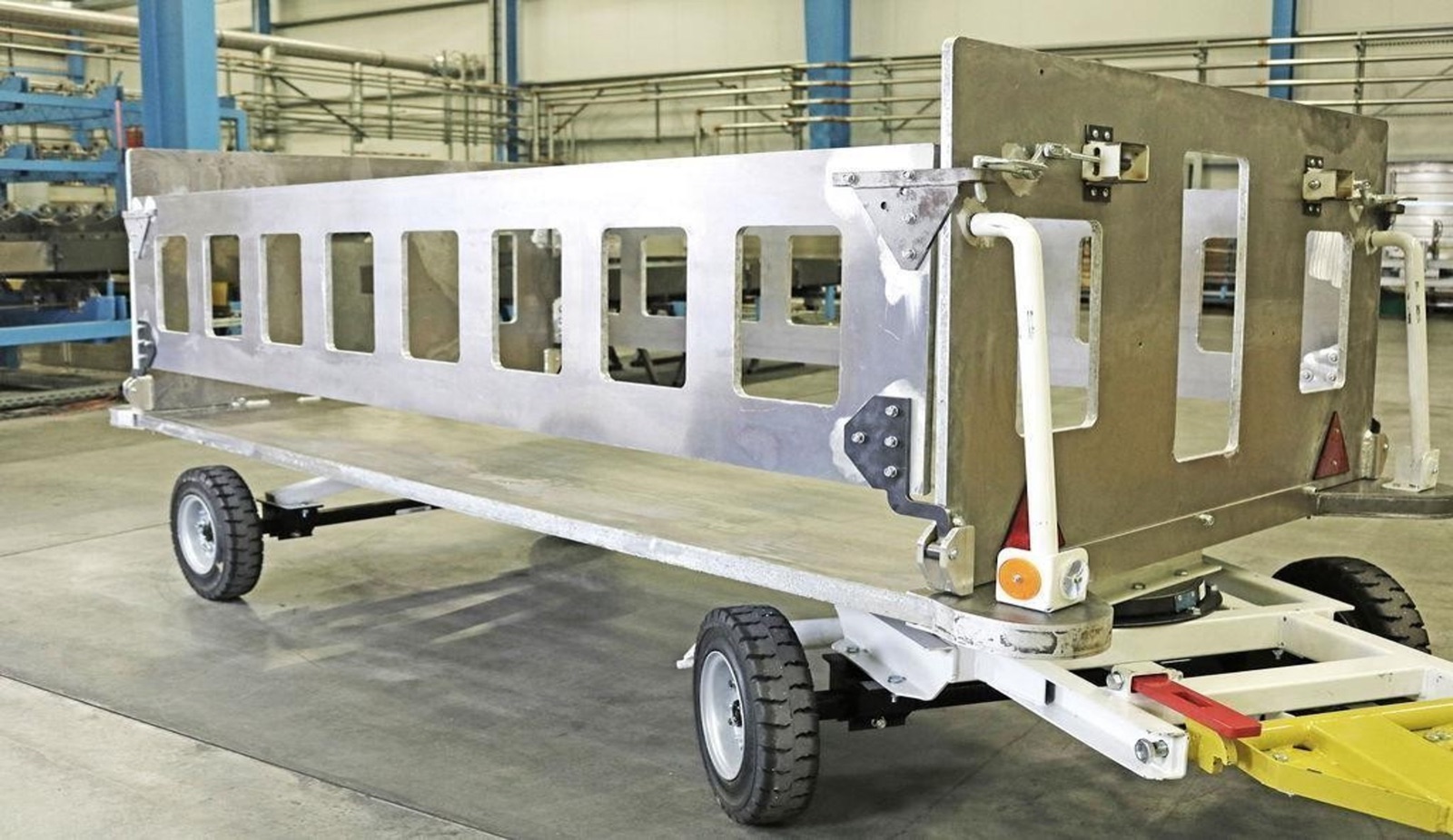
- Baggage carts
- Air cargo pallets
- Packaging and housings for dangerous goods
- Mobile partitions
What does an air cargo pallet made of aluminum foam offer?
Air cargo pallets and containers are made from AAS, that is, with aluminum cover layers. They are light and weather-resistant, and the high bending stiffness of the sandwich allows a thin construction with the same load capacity. In service, two effects come into play: handling becomes faster, and the lower pallet weight extends the operating time of electrically powered ground vehicles. Havel metal foam produces fittings together with the pallet, such as eyelets for securing nets, rather than having them attached afterwards.
Is there a concept for air-droppable load carriers?
As a design, not as a series product. Havel metal foam has designed a load carrier for dropping generators and batteries: a payload of around 90 kg at a touchdown speed of up to 8 m/s. The carrier measures 800 × 600 × 124 mm and weighs about 14 kg with its foam corners; the corners are dimensioned to absorb 2,880 J. The figures come from the design, not from trials.
What does the material achieve in airport security?
Blast protection at airports is an application example named by Havel metal foam, and airport terminals are on the list of places where mobile protective walls are used. There is one test of what it can withstand: Havel Lite® SAS was tested specifically for use as structural explosion protection and achieved positive results. That is a test result and not a certification: no protection rating against a defined explosive load has been derived from it.
Is the material approved for aviation?
No, and this question belongs at the start of a conversation, not at the end. There is no material approval for aviation so far: there are no cabin material tests to CS-25 or FAR 25.853, nor to the manufacturers' test specifications, and there is no EASA approval. What does exist is the material testing of AAS and SAS to DIN EN 45545-2 from the rail sector; it resulted in classification as HL3, and no certificate was applied for. For an application on board, it is no substitute for a qualification. For applications on the ground, that is, baggage carts, pallets and equipment, the question does not arise with the same urgency.
Havel metal foam carries out material tests with partners, among them the Fraunhofer Institute for Machine Tools and Forming Technology IWU, the Technische Hochschule Brandenburg, MPA Dresden and the Beschussamt Mellrichstadt. None of this covers an aviation-specific qualification.
Approval and records
Which material approval exists for aviation?
Also asked: Is there an EASA approval? · Has the material been tested to CS-25 or FAR 25.853?
None. Havel metal foam does not yet hold a material approval for aviation: there is no EASA approval, no cabin material test to CS-25 or FAR 25.853 and nothing to the aircraft manufacturers' test specifications, neither to ABD nor to AITM. That comes first here because no aviation buyer specifies a cabin or cargo material without fire test evidence, and because an inquiry that only raises this question during the project becomes expensive. What does exist is the material testing of AAS and SAS to DIN EN 45545-2 from rail vehicle construction, with classification as HL3; it is a different record for a different field of application and does not replace an aviation qualification. The material could be tested against an aviation standard; no such test has been run.
- Sources
- Brand content
Where does the existing fire test evidence come from?
Also asked: What does the material testing to DIN EN 45545-2 show? · Does the rail fire test evidence also apply to the cabin?
The record Havel metal foam can present comes from rail vehicle construction: material testing of AAS and SAS to DIN EN 45545-2 resulted in classification as HL3; no certificate was applied for. What carries over is the argument, not the approval: the build-up is purely metallic, with no plastics and no adhesives, so there is nothing present that could burn. For a cabin, that is a plausibility argument, not a test, because the aviation standards call for different test specimens, different flame exposure scenarios and different limit values. There is no fire resistance class for any component.
- Sources
- Brand content
What is documented for structural explosion protection?
Also asked: Has the sandwich been tested against explosions? · Are there protection ratings for blast protection?
Havel metal foam had Havel Lite® SAS tested specifically for use as structural explosion protection, with a positive result. That stands as a passed test and explicitly not as a certification. No protection rating has been derived from it: for the explosion and ballistic tests there is no test house, no date and no report number, and without those three details a protection rating is worthless for a tender. Blast protection at airports is named as an application example. In such build-ups the material works in combination with high-strength steel or ceramic-aramid composites, not on its own.
- Sources
- Brand content
Applications
Which components are named for aviation, and which have been built?
Also asked: Which applications are there in aviation? · Are the aviation applications real or planned?
Havel metal foam sees the material in aviation in seven applications: cockpit, crash element and impact protection, seats with brackets and stairs, baggage carts, packaging or enclosures for dangerous goods, air cargo pallets and mobile partitions. The level of maturity varies widely, and that distinction belongs in the answer: the baggage cart in AAS has been photographed as a built component, the air cargo pallet is described as a product, and the air-droppable load carrier exists as a design. For the other items there is a named application and no documented component. Because aluminum foam absorbs vibrations, shocks and impacts exceptionally well, in aviation it is suited above all to stiffness-, crash- and safety-relevant areas.
- Sources
- Brand content
Why an air cargo pallet made of aluminum foam rather than sheet metal?
Also asked: What does a ULD made of aluminum foam sandwich offer? · Can eyelets be integrated into a pallet?
Havel metal foam produces air cargo pallets from AAS, that is, with aluminum cover layers, and names three advantages over a conventional pallet. It is light and weatherproof, which on a ULD translates directly into payload. It allows fast handling and, through the lower pallet weight, extends the operating time of electrically powered industrial trucks, which is an operating cost argument and not a material argument. And the high bending stiffness of the sandwich allows thin constructions, leaving more height for cargo. Customer-specific fittings such as eyelets for securing nets can be incorporated while the ULD is being produced.
- Sources
- Brand content
What is the air-droppable load carrier designed for?
Also asked: Is there a pallet for air drops? · How much energy does the load carrier absorb?
Havel metal foam has designed a load carrier for generators and batteries that can be dropped from the air; it is a design and not a built component. It is designed for a payload of around 90 kg at a touchdown speed of up to 8 m/s. The tray measures 800 by 600 by 124 mm and weighs about 14 kg with its foam corners, and the corners are dimensioned to absorb 2,880 J. The figures hold as a design and not as a test result: a drop test is still to come. For a project that is the useful information, because the design shows the order of magnitude of energy the material can absorb.
- Sources
- Brand content
Airport security
What does the material achieve at an airport outside the aircraft?
Also asked: Is aluminum foam used for blast protection? · Are there applications in the terminal?
Havel metal foam serves two areas at airports outside the aircraft. The first is blast protection, explicitly listed as an application example, with Havel Lite® SAS as tested structural explosion protection and with no published protection rating. The second is mobile partitions, for which airport terminals are on the list of applications. These applications are easier to procure than a cabin component, because no aviation approval stands in the way: a terminal is a building, and the rules of construction and building security apply. We clarify for each project which of them a component meets.
- Sources
- Brand content
What needs to be clarified early in an aviation project?
Also asked: What information does an aviation inquiry need? · How does a qualification proceed?
For an aviation project with aluminum foam, three points need to be clarified early, and the first is the most expensive if it is left open. First, the qualification route: for a component in the cabin or the cargo hold, it has to be clarified which standard it must be tested against and who commissions that test, because Havel metal foam does not have it. Second, the load case, because the existing figures are design values, not test results. Third, whether the component sits in the aircraft or on the ground: no aviation approval applies to baggage carts, pallets, partitions and blast protection at the terminal, and there the route to a component is considerably shorter. This order decides whether a project takes months or years.
- Sources
- Brand content
Aluminum foam for your aviation application
Tell us where the component sits; we will tell you which records are available.
- Prompt reply
- No account needed
- Your data stays confidential