
Material values of aluminum foam
Aluminum foam has a density of 0.5 to 0.8 g/cm³, against 7.85 g/cm³ for steel (S235JR) and 2.7 g/cm³ for aluminum (EN-AW 5754). In the 10-1-1 build-up (1 mm cover layers, foam core 0.7 g/cm³), a plate of 1,000 × 1,000 × 10 mm³ weighs about 11 kg as an aluminum foam sandwich with aluminum cover layers (AAS), 21.3 kg as a steel-aluminum foam sandwich (SAS) and 78.5 kg in steel. The full values are in the table below.
Updated:
What values do aluminum foam and the sandwiches have compared with steel and aluminum?
The table compares aluminum foam (AlSi10) and the two sandwich designs, AAS with aluminum cover layers and SAS with steel cover layers, each in a 1/8/1 build-up, with S235JR steel and soft aluminum EN-AW 5754 (AlMg3). All values are analytically determined guide values; for a specific application they have to be determined for that case.
| Property | Unit | Steel (S235JR) | Aluminum (EN-AW 5754) | AAS (aluminum cover layers) | SAS (steel cover layers) | Aluminum foam (AlSi10) |
|---|---|---|---|---|---|---|
| Density | g/cm³ | 7.85 | 2.7 | 0.5 to 0.8 (core) · 2.7 (cover layer) | 0.7 (core) · 7.85 (cover layer) | 0.5 to 0.8 |
| Young's modulus | GPa | 210 | 70 | 0.33 to 0.76 (core) · 70 (cover layers) | 0.6 (core) · 210 (cover layers) | 0.33 to 0.76 |
| Poisson's ratio | dimensionless | 0.3 | 0.34 | 0.3 to 0.34 | 0.31 to 0.34 | 0.31 to 0.34 |
| Compressive strength | N/mm² | not given | not given | 2.5 to 10 (core) | 8.5 (core) | 2.5 to 10 |
| Yield strength | N/mm² | 235 | 100 | not given | 140 to 280 (cover layer) | not given |
| Tensile strength | N/mm² | 340 | 180 | 120 to 200 | 270 to 410 (cover layer) | 4 to 6.3** |
| Bending stiffness | mm/1,000 N | 1.2 | 3.6 | 6.8** | 2.4 | 22 to 41** |
| Thermal conductivity | W/mK | 48 to 58 | 170 to 220 | 10 to 15 (core) · 170 to 220 (cover layer) | 25 (core) · 48 to 58 (cover layer) | 12 to 36 |
| Mass 1,000 × 1,000 × 10 mm³ | kg | 78.5 | 27 | about 11 (AAS 10-1-1, core 0.7 g/cm³)* | 21.3 (SAS 10-1-1, core 0.7 g/cm³) | 5 to 8* |
The foam core is regularly produced at 0.5 to 0.8 g/cm³, higher densities by agreement. Young's modulus and compressive strength of the foam core are given by density, according to the AAS, SAS and Havel Lite® product data sheets (0.5 g/cm³ → 330 N/mm² / 2.5 N/mm² · 0.6 → 450 / 6.5 · 0.7 → 600 / 8.5 · 0.8 → 760 / 10); the SAS column gives the value for this build-up's core density of 0.7 g/cm³. Yield strength and tensile strength of the SAS cover layer: DC01 (1.0330) steel to DIN EN 10130. *Material properties of sandwiches and aluminum foam depend strongly on the material density. **Material properties depend strongly on the specific geometry. Sources for the calculation: Tabellenbuch Metall, 43rd edition, 2005; Fraunhofer Institute for Machine Tools and Forming Technology IWU. All values were determined analytically and are guide values only; for a specific application they have to be determined separately.
What values does the aluminum foam core have at each density?
The product data sheets give the values of the closed-cell foam core as mean values over seven density grades. The values apply column by column: each density has its own Young's modulus, compressive strength and thermal conductivity. All three product data sheets, AAS, SAS and Havel Lite®, give the same core, because it is the same material. Of these, the first four grades are regularly produced, 0.5 to 0.8 g/cm³; higher densities by agreement and after prior testing.
| Property | Unit | 0.5 | 0.6 | 0.7 | 0.8 |
|---|---|---|---|---|---|
| Density | g/cm³ | 0.5 | 0.6 | 0.7 | 0.8 |
| Young's modulus | N/mm² | 330 | 450 | 600 | 760 |
| Compressive strength | N/mm² | 2.5 | 6.5 | 8.5 | 10 |
| Thermal conductivity | W/mK | 11 | 15 | 20 | 25 |
| Shear strength | N/mm² | 2.0 | 2.0 | 2.0 | 2.0 |
| Poisson's ratio | dimensionless | 0.31 to 0.34 | 0.31 to 0.34 | 0.31 to 0.34 | 0.31 to 0.34 |
Source: AAS, SAS and Havel Lite® product data sheets. The data sheets also list the grades 0.9, 1.0 and 1.1 g/cm³; the regularly produced range is 0.5 to 0.8 g/cm³, higher densities by agreement. Coefficient of thermal expansion α (20 to 100 °C) = 23.9 · 10⁻⁶ K⁻¹. Operating temperature −20 to 200 °C with no loss of properties; maximum temperature 600 °C.
Which thicknesses, formats and alloys are available?
The three designs differ in total thickness, cover layer thickness, maximum format and alloy. AAS has aluminum cover layers, SAS has steel cover layers, and Havel Lite® is the panel without cover layers. The maximum formats, listed in the product data sheets, are why, for large surfaces, the design is chosen before the geometry.
| AAS | SAS | Havel Lite® | |
|---|---|---|---|
| Total thickness | 6 to 60 mm | 8 to 40 mm | 3 to 50 mm |
| Cover layer per side | 1 to 8 mm | 1.5 to 5 mm | none |
| Maximum format | 2,800 × 1,400 mm | 2,950 × 1,450 mm | 1,900 × 900 mm |
| Cover layer alloy | EN AW-6082 | DC01 (1.0330) | n/a |
| Core alloy | AlSi10 | AlMgSi0.6 | AlSi10 |
| Bond between core and cover layer | metallic, no adhesive | metallic, no adhesive | n/a |
Source: AAS, SAS and Havel Lite® product data sheets. Features without an individual tolerance are toleranced to ISO 2768-1 and ISO 2768-2.
Which densities are available?
The standard is 0.6 to 0.7 g/cm³, and regular production covers 0.5 to 0.8 g/cm³; higher densities by agreement and after prior testing. Within the regular range the density is matched to the application: a lower density for maximum weight saving, a higher density for higher compressive strength and stiffness. The table above shows how strong the effect is: between 0.5 and 0.8 g/cm³, Young's modulus rises from 330 to 760 N/mm² and compressive strength from 2.5 to 10 N/mm². That is why density should be settled early in the design.
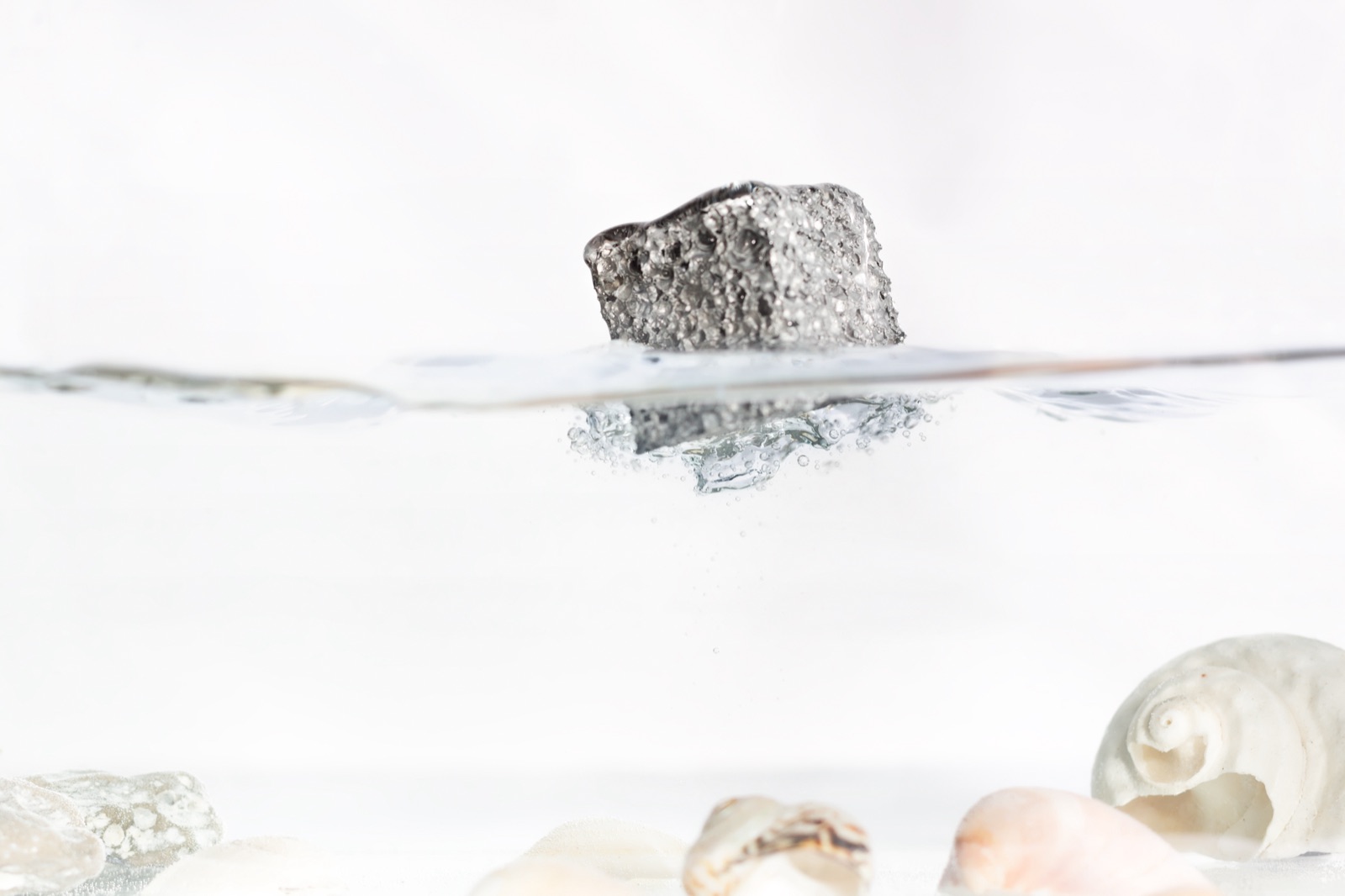
Density and design
How is the density of the foam core chosen in design?
Also asked: What changes with density? · How does the core density affect strength?
At Havel metal foam, density is not a material constant but the design parameter: it sets the stiffness, compressive strength and thermal conductivity of the core. The standard is 0.6 to 0.7 g/cm³, and regular production covers 0.5 to 0.8 g/cm³; higher densities by agreement and after prior testing. Each grade has its own set of values. At 0.5 g/cm³ Young's modulus is 330 N/mm², compressive strength 2.5 N/mm² and thermal conductivity 11 W/mK; at 0.6 they are 450, 6.5 and 15; at 0.7, 600, 8.5 and 20; and finally at 0.8, 760, 10 and 25. Between the lightest and the heaviest regularly produced grade, compressive strength therefore quadruples while mass rises by 60 %. That is why density should be settled early in the design, not at the end.
- Sources
- Brand content
Which core density does each sandwich design have?
Also asked: Does SAS have a different core density from AAS? · At what density is SAS produced?
In the Havel metal foam sandwiches, the AAS core lies in the regularly produced range of 0.5 to 0.8 g/cm³ and the SAS core at 0.7 g/cm³. The 7.85 g/cm³ is the density of the steel cover layer, not that of the core. For a design this means: with AAS the core density is chosen, with SAS it is fixed, and the difference between the designs lies mostly in the cover layer anyway.
- Sources
- Brand content
How reliable are the table values?
Also asked: Are the values guaranteed? · Where do the figures come from?
The table values from Havel metal foam are analytically determined guide values, and that is stated expressly: for a specific application they have to be determined for that case. The basis for the calculation is the Tabellenbuch Metall, 43rd edition of 2005, together with the Fraunhofer Institute for Machine Tools and Forming Technology IWU. Two limitations must always be read with them: the properties of foam and sandwich depend strongly on density, and the geometry-dependent quantities also depend on the geometry of the component. Anyone who needs an assurance for a component gets it from a calculation or a test, not from the table.
- Sources
- Brand content
Heat, expansion and shielding
How well does aluminum foam conduct heat?
Also asked: What is the thermal conductivity of the foam core? · Does the cover layer conduct differently from the core?
Aluminum foam from Havel metal foam conducts heat considerably less well than solid aluminum, because the pores replace part of the cross-section. For the core, the product data sheets give 11 W/mK at 0.5 g/cm³, 15 at 0.6, 20 at 0.7 and 25 at 0.8. In a sandwich, conductivity therefore depends on the layer: the core has 10 to 15 W/mK in AAS and 25 W/mK in SAS, the cover layer 170 to 220 W/mK in aluminum and 48 to 58 W/mK in steel. A sandwich therefore conducts heat along its surface through the cover layer and only slowly across the core, which makes it useful as a separating layer.
- Sources
- Brand content
What is the material's coefficient of thermal expansion?
Also asked: How much does aluminum foam expand when heated? · What needs attention when it is joined to steel?
For aluminum foam from Havel metal foam, the product data sheets give a coefficient of thermal expansion of 23.9 times 10 to the power of minus 6 per kelvin, measured in the range 20 to 100 °C. That is the value of aluminum, not that of a foam with a characteristic of its own: it is the metal framework that expands, and the pores change nothing about that. The figure matters when the foam is joined to another material, for example to a steel structure, because a temperature change there produces a restraint stress that belongs in the design of the fastening. Within an SAS sandwich the effect is already accounted for in the design.
- Sources
- Brand content
Has the electromagnetic shielding been measured?
Also asked: Does aluminum foam shield electromagnetic fields? · To which standard was the shielding tested?
Yes. The shielding attenuation of aluminum foam from Havel metal foam was measured by the Fraunhofer Institute for Machine Tools and Forming Technology IWU to EN 50147-1 on six named samples. The measurement is available as a diagram, from which the values for each sample can be read. One result holds even without individual values: the lightest sample, a 30 mm thick foam without a cast skin, and so with an open-cell surface, at 1.0 kg, lies in the upper band of the family of curves. With this material, shielding is therefore not simply bought with mass, which sets it apart from a sheet-metal solution.
- Sources
- Brand content
Strength and tolerances
What is the tensile strength of aluminum foam?
Also asked: Does the foam or the cover layer carry the tensile force? · What tensile strength does a sandwich have?
Pure aluminum foam from Havel metal foam reaches a tensile strength of 4 to 6.3 N/mm², and that is the most important limit of the material: it is built for compression and for energy absorption, not for tension. In a sandwich the cover layer therefore takes the tensile force. For AAS, 120 to 200 N/mm² is given; the DC01 steel cover layer of SAS has a tensile strength of 270 to 410 N/mm² and a yield strength of 140 to 280 N/mm². The design rule that follows is to place a fiber under tension in the sheet and let the core transmit the shear force. For this, the shear strength of the core is given as 2.0 N/mm² across the whole density range, and Poisson's ratio as 0.31 to 0.34.
- Sources
- Brand content
- Fact sheet
To which standards do the tolerances apply?
Also asked: Which tolerance classes are agreed? · Are there figures for form tolerance?
For all features without a specification of their own, Havel metal foam applies ISO 2768-1 for linear, angular and radius dimensions and ISO 2768-2 for tolerances of form and position. The English data sheets spell out the classes: f for fine, m for medium, c for coarse and v for very coarse. For an order this means that a tolerance tighter than the agreed class must be stated separately on the drawing. With a foamed component, this is where the effort is decided, because the thickness tolerance in foaming is plus or minus 0.3 to plus or minus 0.8 mm.
- Sources
- Brand content
Up to what temperature are the values valid?
Also asked: In which temperature range do the table values apply? · At what point do the properties change?
The values from Havel metal foam apply within the operating temperature range that the product data sheets give as −20 to 200 °C with no loss of properties; they give 600 °C as the maximum temperature. The coefficient of thermal expansion is stated expressly for 20 to 100 °C, so it cannot be assumed to hold across the whole range without testing. Above 200 °C the table values are therefore no longer a basis for design, and a component for that range is calculated or tested. No data sheet gives values above 600 °C.
- Sources
- Brand content
Reliable values for your case
Researching material values? Tell us your case and we will supply reliable values for your design.
- Prompt reply
- Reliable values, not marketing figures
- No account needed