
Materials from Havel metal foam
Havel metal foam produces three material families: aluminum foam as a solid material, aluminum foam sandwiches with steel or aluminum cover layers (SAS and AAS), and zinc foam. All three are made by powder metallurgy, and that gives the two properties on which the entire portfolio rests: the foam is closed-cell, and it bonds metallically to the cover layers, because the foamable precursor is placed between them before foaming. There is no adhesive step in this sequence.
Updated:
Which materials does Havel metal foam produce?
Three families, which differ not in the material but in the build-up. Solid aluminum foam is pure foam without cover layers and the lightest variant. Aluminum foam sandwiches place the same foam as a core between two cover layers, of aluminum (AAS) or of steel (SAS); the cover layers carry the bending load, which is why a sandwich is used where stiffness is required. Zinc foam is the third family and the newest: it can foam particularly thin profile and tube walls, which aluminum foam cannot do in the same way.
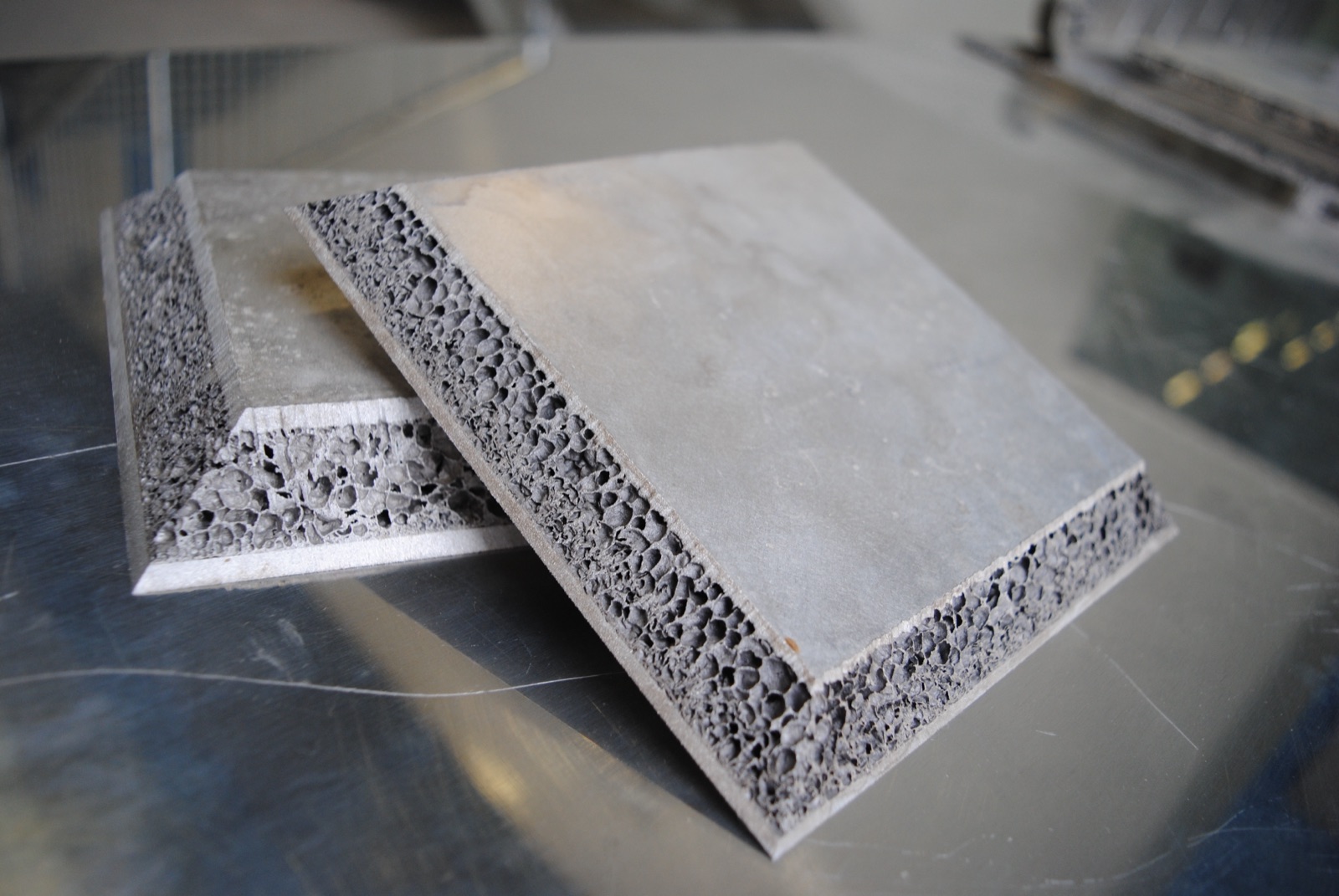
- Aluminum foam: solid, closed-cell, without cover layers
- Aluminum foam sandwiches: AAS with aluminum cover layers, SAS with steel cover layers
- Zinc foam: for particularly thin-walled profiles and tubes
What follows from the powder metallurgy process?
Two properties, and both are the reason for almost everything else. Havel metal foam makes the foam by powder metallurgy, not by the melt route, and the result is a closed-cell foam: the cells are sealed off from one another, which is why the material is non-combustible, can be bonded metallically and is not sensitive to water. The second property is the bond itself. The foamable precursor is placed between the cover layers and foams against them, so that a metallic bond forms. There is no adhesive in this sequence, and it follows that the composite stays single-material and therefore 100 % recyclable.
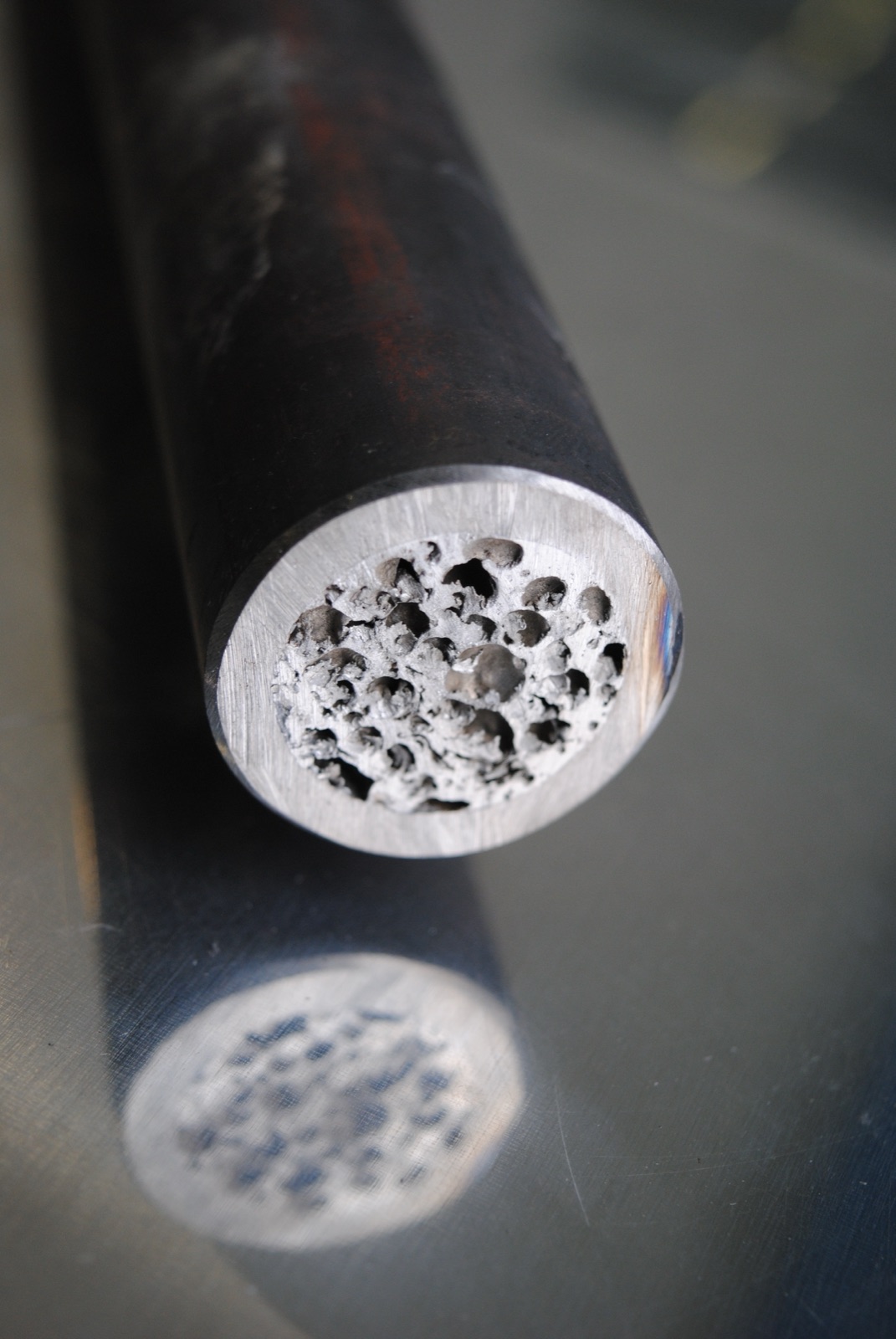
Two documented exceptions where adhesive is used after all: inserting tubes afterwards, and the bonded-in foam ring in the toothed flange.
Which material is suited to which component?
The decision is made in two steps, and the first is not the material but the build-up. First: does the component carry a bending load? Then a sandwich is the answer, because the stiffness comes from the cover layers and not from the foam. Solid foam is considerably softer than sheet metal and does not replace it one to one. Second, if a sandwich fits: steel or aluminum cover layers? Steel makes the composite stiffer and is the only design that allows foamed-in or welded-in fastening points; aluminum keeps the component lighter and conducts heat better. If the task is not carrying a load but damping, absorbing or sound, solid foam plays to its strengths. And if an existing thin-walled profile is to be foamed, zinc foam is the family that can do it.
The choice does not replace design work: the values are analytically determined guideline values and are determined separately for a specific application.
- Carrying a bending load? A sandwich: the cover layers carry it, not the foam
- Stiffness or foamed-in fastenings? SAS with steel cover layers
- Weight or heat conduction? AAS with aluminum cover layers
- Damping, absorbing, sound? Solid aluminum foam
- Foaming a thin-walled profile or tube? Zinc foam
Where are the material values?
On the Material values page, complete and broken down by density. Havel metal foam sets the available density range of the foam core at 0.5 to 0.8 g/cm³, and within this range the density is designed for the application: lower density for weight, higher for strength. Because Young's modulus, compressive strength and thermal conductivity all depend on the density, it is the first design parameter, not a downstream one. The full table for each density grade, the formats for each design and the operating temperatures are all there; this page does not repeat them.
Which material suits your component?
Describe the task and the boundary conditions; a specialist will assess it.
- Prompt reply
- No account needed
- Your data stays confidential