
Aluminum foam for defense and security
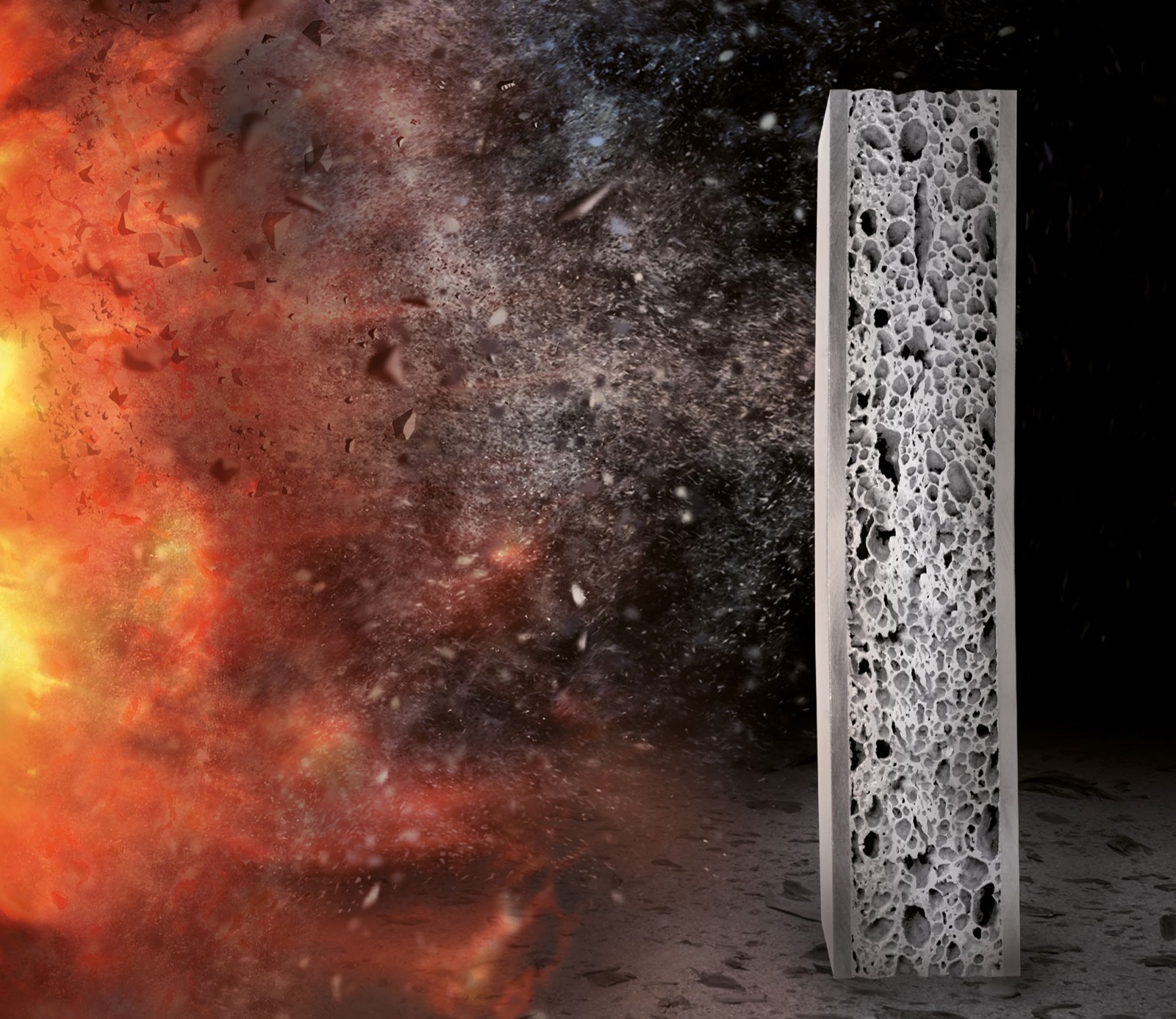
Aluminum foam systems are suitable for applications in personal and building protection. They are distinguished above all by their effect as explosion protection and by their resistance to fire: thanks to its cellular structure, aluminum foam is able to convert large quantities of kinetic energy into deformation energy. With aluminum foam sandwiches, buildings, containers and vehicles can be equipped faster, with less weight and therefore at lower cost.
Updated:
How does aluminum foam protect against explosions and fire?
The protective effect rests on the cellular structure of the material: aluminum foam converts large quantities of kinetic energy into deformation energy, and that makes it effective as explosion protection. Added to this is its resistance to fire. As prevention and as a protective measure, its use minimizes damage from terrorist attacks as well as harm to personnel and damage to installations; safety vests and helmets are also among the fields of use named.
Which fire protection evidence and packaging standards apply to aluminum foam in defense?
Aluminum foam is non-combustible and gives off no toxic gases. Material testing of AAS and SAS to DIN EN 45545-2 resulted in classification as HL3; no certificate was applied for. UN 6A, 6B and 6C, by contrast, are not a material classification but the standard to which transport packaging for explosives is tested: aluminum foam can be used in it as an energy absorber, for example to allow smaller packages. In one project this standard was decisive, and the project was carried out with aluminum foam.
- Non-combustible
- DIN EN 45545-2: classified HL3 (material testing of AAS and SAS); no certificate was applied for.
- No toxic gases
- The build-up is purely metallic, with no plastics and no adhesives.
- Transport of explosives
- UN 6A, 6B and 6C is the standard to which transport packaging for explosives is tested. Aluminum foam can serve in it as an energy absorber and so allow a smaller package; in one project this was decisive.
Where are aluminum foam protection systems used?
The application areas range from SOC equipment through civil infrastructure to military installations: airports, power plants, central government facilities, embassies and consulates, security buildings such as control centers and police stations, vehicles such as armored vehicles, and logistics facilities in critical regions. With aluminum foam sandwiches, buildings, containers and vehicles can be equipped faster, with less weight and therefore at lower cost.
- SOC equipment
- Airports
- Power plants
- Central government facilities
- Embassies, consulates
- Security buildings, e.g. control centers, police stations
- Military installations
- Vehicles, e.g. armored vehicles
- Logistics facilities in critical regions
What is mobile quick protection made of aluminum foam?
Quick protection is a mobile safety room made of aluminum foam partitions for security-relevant areas, for example when an unattended suitcase is found in an airport terminal and the surroundings must be secured as quickly as possible. The elements can be combined freely into a mobile safety room of 3 to 6 walls and are set up within a few seconds. In the event of an explosion, the aluminum foam absorbs a substantial part of the explosive force; the effect on the immediate surroundings can be effectively reduced.
The material: aluminum foam panels from 10 mm to 50 mm thick, depending on the application, as individual walls on a stand system with castors. As room dividers they can carry advertising and so possibly offset their cost.
How has fire and explosion protection been developed further?
Havel metal foam has developed its aluminum foam further for the requirements of the Chinese standard GB 38031 (2020) and the European standard ECE 100. Both are standards, not Havel certifications: GB 38031 is the Chinese standard for traction batteries, updated in 2025, and contains mechanical and thermal load cases in which aluminum foam comes into its own; there are ongoing projects in which the standard is decisive and which are being implemented with aluminum foam. Integrating fiber mats increases fire protection, and all the other positive properties of aluminum foam are retained, among them sound insulation, high energy absorption capacity and crash protection, vibration damping, weldability and 100 % recyclability.
- Sound-insulating
- High energy absorption capacity, crash protection in vehicles
- Vibration-damping
- Weldable
- 100 % recyclable
Working principle and fire behavior
How does aluminum foam work as a protective material?
Also asked: What happens in a pressure wave? · Why does the cell structure absorb energy?
Aluminum foam from Havel metal foam converts kinetic energy into deformation work. Under overload the cell walls buckle one after another and the foam compacts instead of passing the load on as an impact; the load-bearing structure behind it is protected as a result. What matters is that the energy is dissipated over a distance and not through a fracture. It is precisely this mechanism that is on record and can be described, regardless of which protection class a particular build-up achieves.
- Sources
- Brand content
How does the material behave in a fire?
Also asked: Are toxic gases produced? · What fire evidence is available?
The Havel metal foam build-up is purely metallic, with no plastics and no adhesives, so no toxic gases can come from the material in a fire. Material testing of AAS and SAS to DIN EN 45545-2 resulted in classification as HL3; no certificate was applied for. A fire resistance class is expressly not given: such a class is a classification based on a test report for a particular component build-up, and no such report exists.
- Sources
- Brand content
Has the material been tested as explosion protection?
Also asked: Have blast tests been carried out? · Which explosion protection values are on record?
Yes, tested. Havel Lite® SAS was tested specifically for use as structural explosion protection and achieved positive results. Tested here means a blast test, not certification: for these tests neither the test body nor the date nor the report number is stated, which is why Havel metal foam publishes no figures for them. If you need a protection value for a project, you receive the test documents through an inquiry; a figure without a test report could not be used in a tender anyway.
- Sources
- Brand content
Limits of the evidence
Does aluminum foam protect against gunfire?
Also asked: Has the material been ballistically tested? · Can metal foam replace armor?
Not on its own. The statement from Havel metal foam is: in combination with high-strength steel or ceramic-aramid fiber composites, aluminum foam can be used in areas of ballistic protection. The foam is therefore one layer of a build-up and never ballistic protection as a material. No protection class is given and none is described as certified, because the firing test documents available show results, not certificates, and because the test body and report number are missing. The build-up itself can be described: armor steel or Ramor sheets, the foam between them, and an organic cover layer behind.
- Sources
- Brand content
What role does the material play in transport packaging for explosives?
Also asked: Are the packages approved to UN 6A? · What do UN 6A, 6B and 6C mean?
Aluminum foam from Havel metal foam can act as an energy absorber in transport packaging for explosives. UN 6A, 6B and 6C are the standard to which transport packaging for explosives is tested, not a classification of a material; the foam inside allows smaller packages. There was one project on this. There is no approval of the material to these standards, and none is claimed; what is tested is always the finished package.
- Sources
- Brand content
Products
What do ceiling elements for mobile protective structures do?
Also asked: How are mobile bunkers roofed? · What load does a ceiling element carry?
The ceiling elements from Havel metal foam are made of AAS 30 3 3, that is, with only 6 mm of aluminum in the cover layers, and carry one metric ton per square meter without a substructure. They are installed by two people, without welding and without a crane. The practical value lies in this combination: an element that a team of two can install without lifting gear can be put up where a conventional ceiling needs logistics. No statement is made here about the protective effect achievable against a specific munition.
- Sources
- Brand content
How quickly is a mobile protective wall in place?
Also asked: What is mobile quick protection? · How are the walls set up?
The mobile protective walls from Havel metal foam consist of aluminum foam panels 10 to 50 mm thick, depending on the application, stand on a plug-in castor system and are coupled firmly with U-brackets; a common format is 1,500 × 2,000 mm. They are set up in a few seconds, which is why they are intended as an immediate measure when a suspicious object has been left behind. In normal operation the same walls serve as room dividers. This says nothing about a level of protection against a particular munition.
- Sources
- Brand content
Protection solutions made of aluminum foam
Straight to our specialist team, in confidence and without going through sales.
- Prompt reply
- No account needed
- Your data stays confidential