
Aluminum foam sandwiches (AAS & SAS)
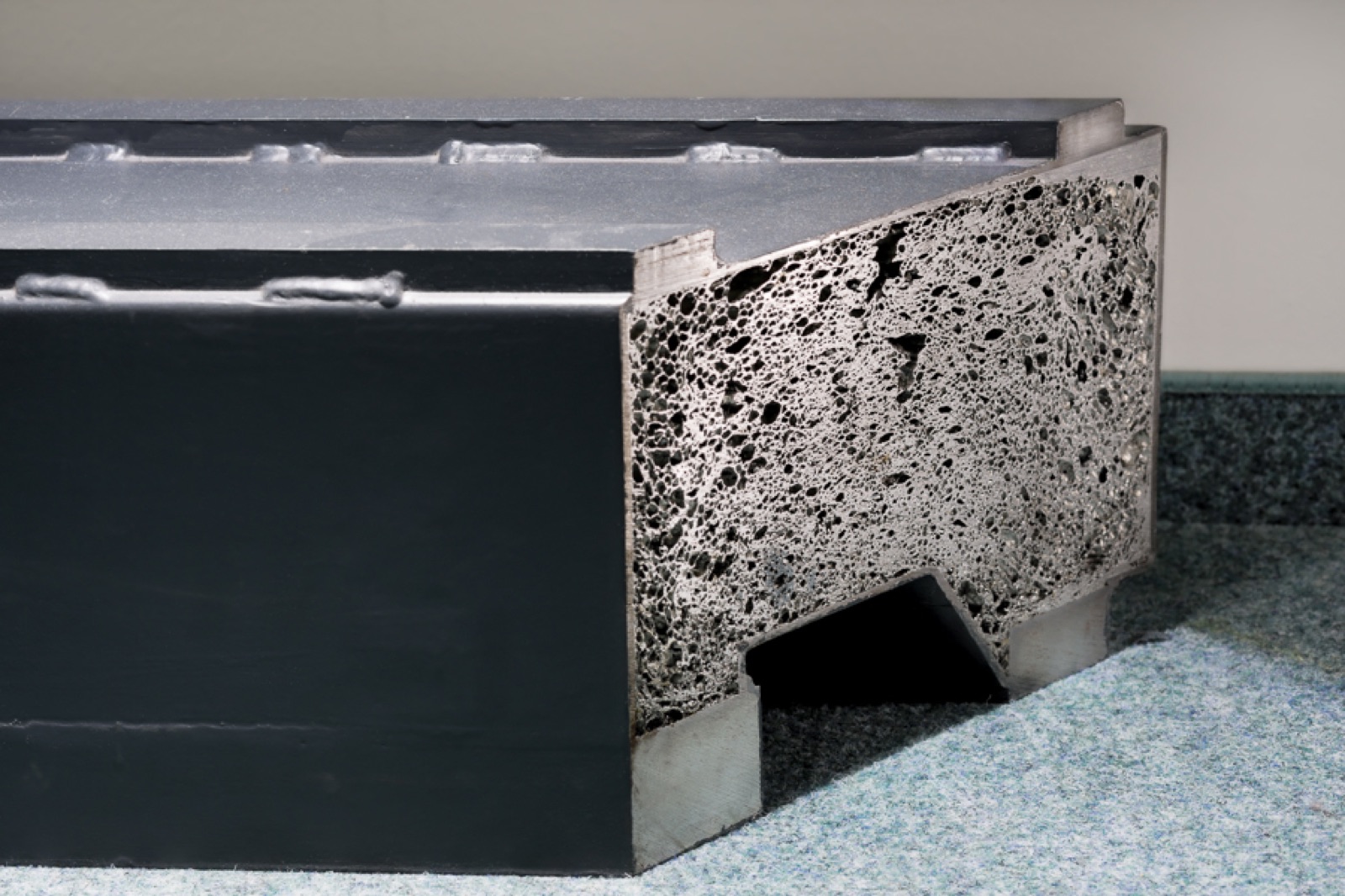
Aluminum foam sandwiches consist of an aluminum foam core with metallic cover layers, produced as Havel Lite® AAS with aluminum cover layers or as Havel Lite® SAS with steel cover layers. The bond between the materials is entirely metallic, with no adhesive; material testing of AAS and SAS to DIN EN 45545-2 resulted in classification as HL3; no certificate was applied for. The weight effect: a plate of 1,000 × 1,000 × 10 mm³ weighs about 11 kg as AAS 10-1-1 (1 mm aluminum cover layers, foam core 0.7 g/cm³), while the same plate in steel weighs 78.5 kg.
Updated:
What are AAS and SAS sandwiches?
AAS and SAS are the two sandwich designs of the Havel Lite® series: an aluminum foam core is produced as a composite with metallic cover layers, of aluminum in the AAS (aluminum-aluminum foam sandwich) and of DC01 (1.0330) steel in the SAS (steel-aluminum foam sandwich). In both cases the core is aluminum foam made by powder metallurgy (PM): AlSi10 in the AAS, AlMgSi0.6 in the SAS. Customer-specific alloys and coated cover layers can also be considered.
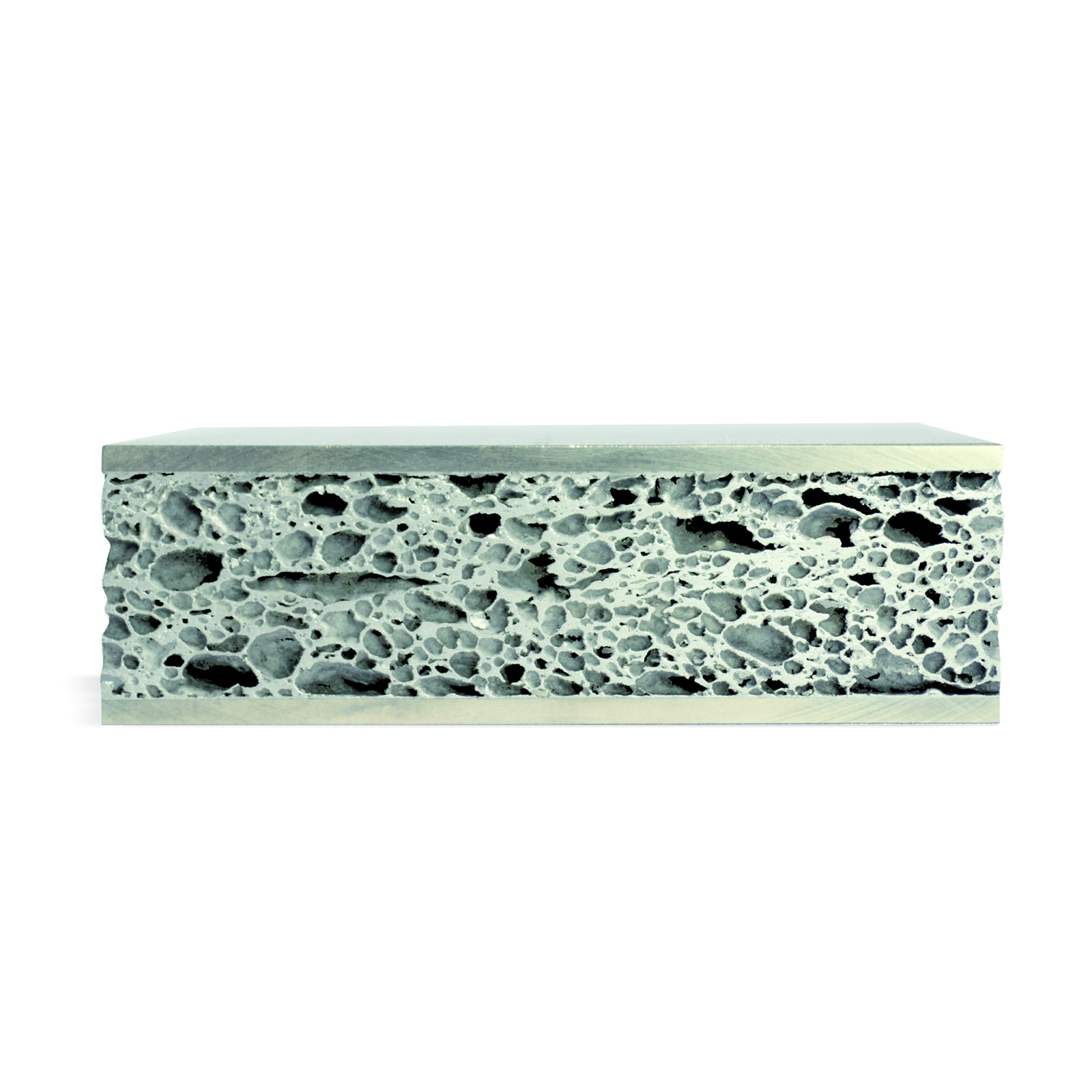
- Havel Lite® AAS
- Aluminum-aluminum foam sandwich: cover layers of aluminum EN AW-6082, core of aluminum foam AlSi10 (PM).
- Havel Lite® SAS
- Steel-aluminum foam sandwich: cover layers of DC01 (1.0330) steel, core of aluminum foam AlMgSi0.6 (PM).
Why do the sandwiches need no adhesive?
The bond between the aluminum foam core and the cover layers is entirely metallic; nothing is glued. That has two consequences. Material testing of AAS and SAS to DIN EN 45545-2 resulted in classification as HL3, and no certificate was applied for; and the material remains a single, unmixed metal. Because no adhesives are used, structures made of aluminum foam are non-combustible and add nothing to the fire load, and the material is 100 % recyclable.
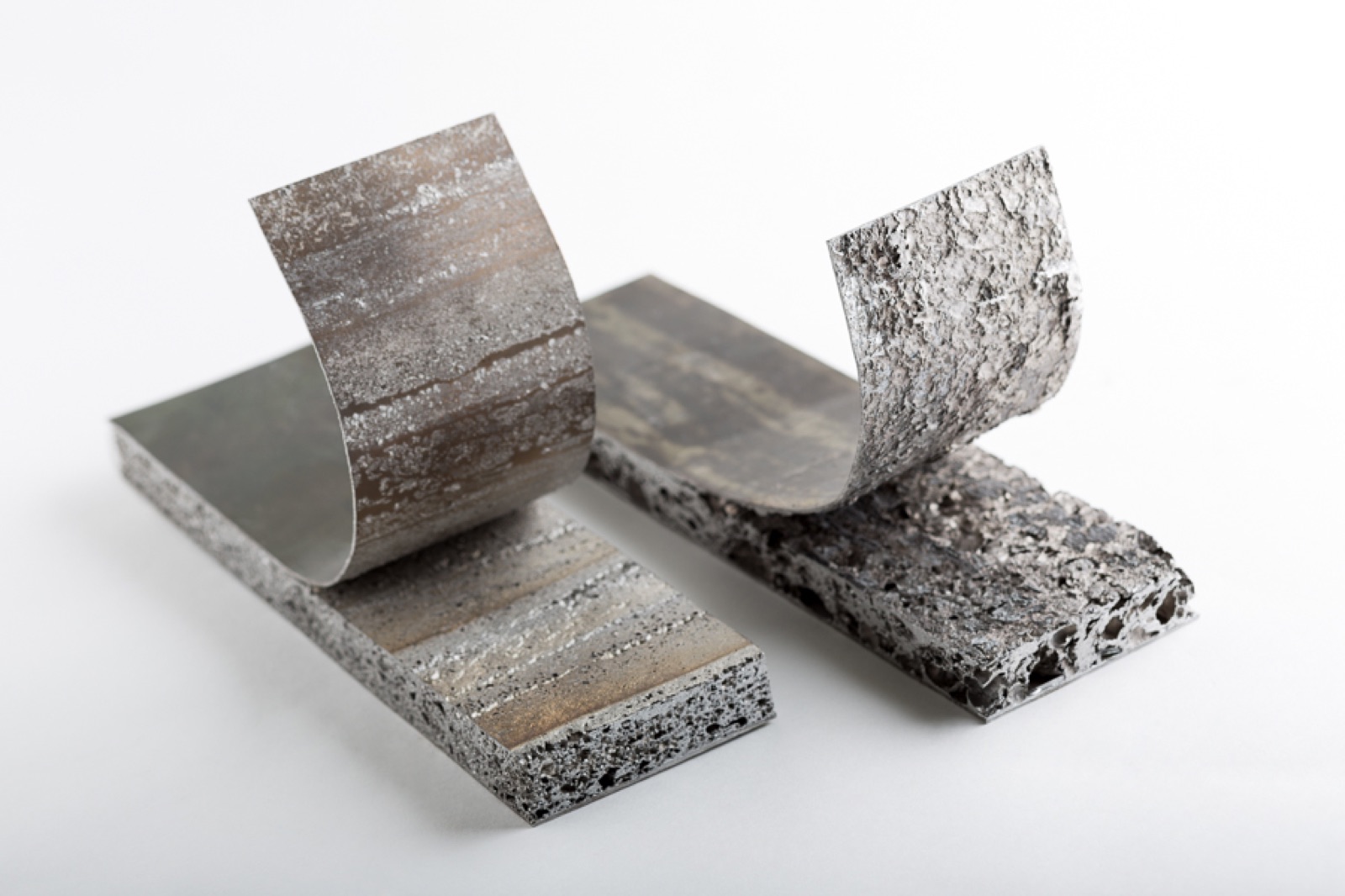
How is a sandwich built up, and what does 1/8/1 mean?
The reference build-up for the material values is the 1/8/1 sandwich: two thin cover layers with the much thicker aluminum foam core between them, in the ratio 1/8/1 (cover layer/core/cover layer). In the AAS the cover layers are aluminum, and in the SAS they are DC01 (1.0330) steel; the core is aluminum foam made by powder metallurgy. At a total thickness of 10 mm that means a 1 mm cover layer, an 8 mm core and a 1 mm cover layer, designated AAS 10-1-1 or SAS 10-1-1. The mass values of the 1,000 × 1,000 × 10 mm³ reference plate refer to this build-up with a foam core of 0.7 g/cm³.
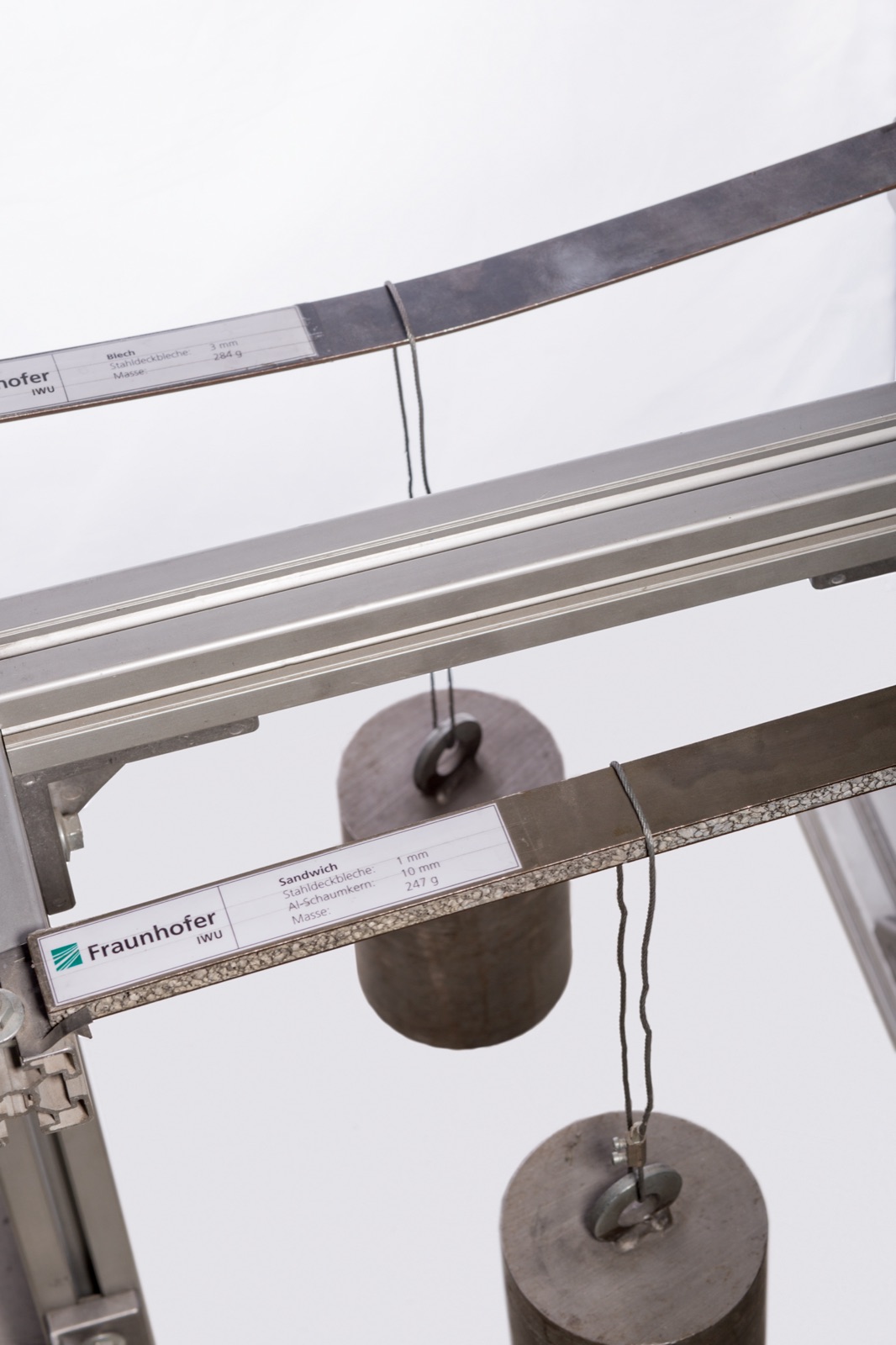
Material values according to Tabellenbuch Metall (43rd edition, 2005) and the Fraunhofer Institute for Machine Tools and Forming Technology IWU; analytically determined guide values.
How much weight does an aluminum foam sandwich save?
The direct comparison on a plate of 1,000 × 1,000 × 10 mm³: steel (S235JR) weighs 78.5 kg, aluminum (EN-AW 5754) 27 kg. As a steel-aluminum foam sandwich SAS 10-1-1 (1 mm steel cover layers, foam core 0.7 g/cm³) it is 21.3 kg, as an aluminum-aluminum foam sandwich AAS 10-1-1 (1 mm aluminum cover layers, foam core 0.7 g/cm³) about 11 kg, and as aluminum foam alone, 5 to 8 kg. The AAS sandwich therefore weighs about 11 kg where a steel plate weighs 78.5 kg.
| Material | Mass |
|---|---|
| Steel (S235JR) | 78.5 kg |
| Aluminum (EN-AW 5754) | 27 kg |
| SAS 10-1-1 (steel cover layers, core 0.7 g/cm³) | 21.3 kg |
| AAS 10-1-1 (aluminum cover layers, core 0.7 g/cm³) | about 11 kg* |
| Aluminum foam (AlSi10) | 5 to 8 kg* |
*Material properties of sandwiches and aluminum foam depend strongly on the material density. The sandwich values apply to the 10-1-1 build-up: 1 mm cover layers, an 8 mm foam core at 0.7 g/cm³. Analytically determined guide values (Tabellenbuch Metall, 43rd edition 2005; Fraunhofer IWU); to be determined individually for specific applications.
When to choose AAS and when SAS?
AAS with aluminum cover layers is the lightest sandwich variant: as AAS 10-1-1 (1 mm aluminum cover layers, foam core 0.7 g/cm³) the plate of 1,000 × 1,000 × 10 mm³ weighs about 11 kg. SAS with steel cover layers, as SAS 10-1-1 (1 mm steel cover layers, foam core 0.7 g/cm³), is heavier at 21.3 kg, but considerably stiffer: the cover layers determine the stiffness of the composite, and steel, at 210 GPa, has three times the Young's modulus of aluminum (70 GPa). In addition, the SAS process allows fastening points, fastening rails or nuts to be foamed in or welded in directly.
How are sandwiches fastened and processed?
Aluminum foam sandwiches can be processed mechanically: drilling, welding and milling are possible, as are bent sandwiches and welded sandwich structures. Any fastening points, fastening rails or nuts required can be foamed in or welded in with SAS; both are limited to the SAS design, and neither is possible with aluminum cover layers (AAS).
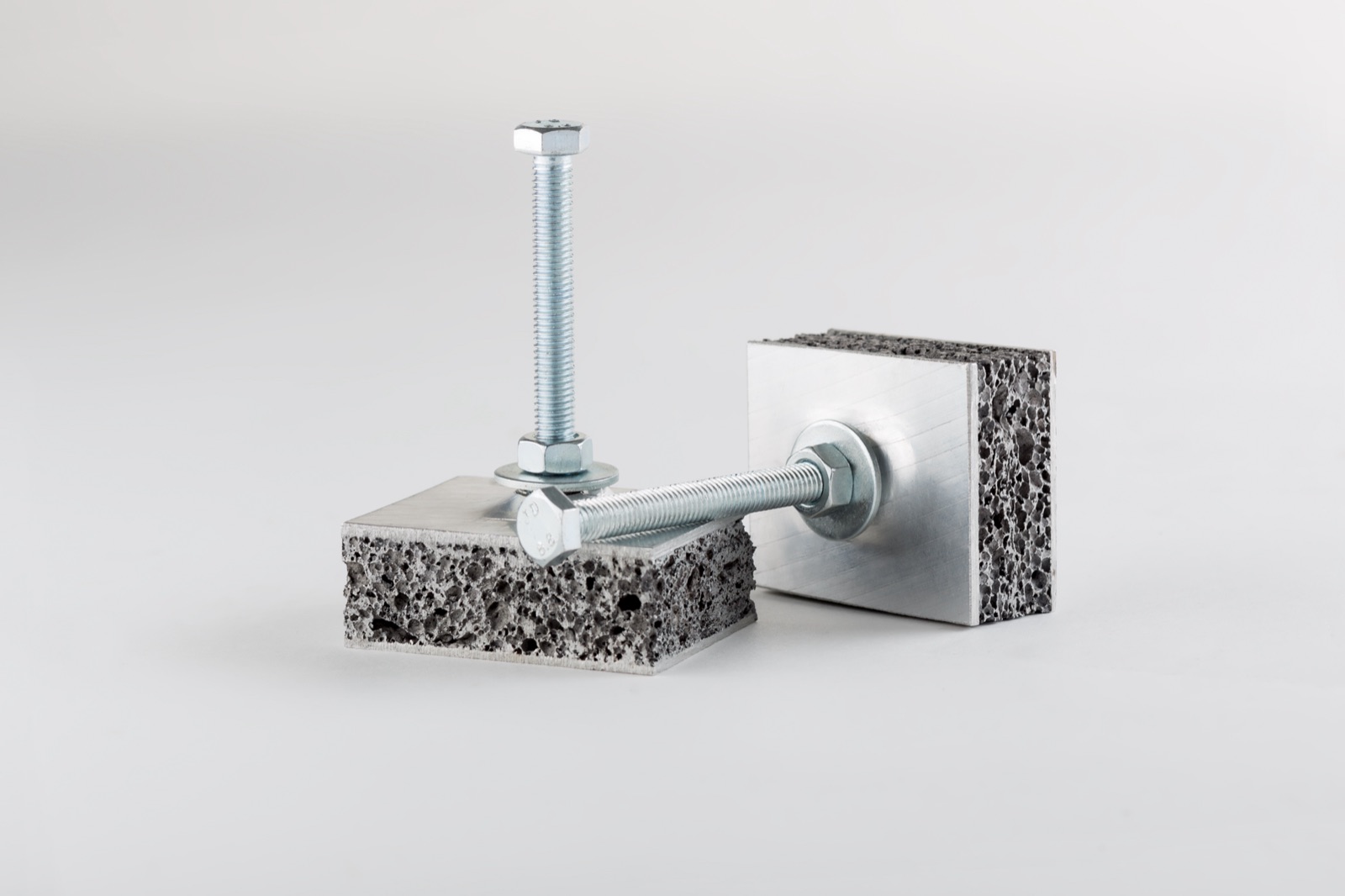
- Drilling, welding, milling
- Bent sandwiches
- Welded aluminum foam sandwiches
- Bolts and nuts foamed in directly (SAS manufacturing technology)
Which cover layers and coatings are possible?
Besides aluminum and steel cover layers, customer-specific alloys and coatings are conceivable, such as paints, marble, wood or wallpaper. Stainless steel cover layers are also possible: stainless steel offers high corrosion resistance and high fire resistance, and stainless steel tubes and profiles can also be filled with aluminum foam. Havel metal foam offers the coating for all types of cover layer: in a special process it is glued and pressed directly onto the cover layer, and the bond between core and cover layer remains metallic. In design terms this ranges from colorful to premium surfaces with a metal, wood or paint finish, and a coating also brings these advantages:
- Corrosion protection
- Wear protection
- Versatile in use
- Greater resistance to foot traffic
- Rounded edges that are no longer sharp
Build-up and bond
How is an aluminum foam sandwich built up?
Also asked: What is an aluminum foam sandwich made of? · What sits between the cover layers?
An aluminum foam sandwich from Havel metal foam consists of a closed-cell aluminum foam core between two metallic cover layers. Two designs are available: AAS with aluminum cover layers of EN AW-6082 and a core of AlSi10, and SAS with steel cover layers of DC01 and a core of AlMgSi0.6. Both are produced under the Havel Lite® brand.
- Sources
- Brand content
Is the bond between core and cover layer glued?
Also asked: Is adhesive used in the sandwich? · How does the foam hold on to the cover layer?
No. In the sandwiches from Havel metal foam the bond forms during foaming: the foamable precursor lies between the cover layers and expands against them as it foams, so that a metallic bond forms. There is no gluing step in the process. Two properties follow directly: the composite stays single-material and therefore fully recyclable, and it is non-combustible. Material testing of AAS and SAS to DIN EN 45545-2 resulted in classification as HL3; no certificate was applied for.
- Sources
- Brand content
Choosing between AAS and SAS
How do AAS and SAS differ?
Also asked: Which design should I choose? · What is the difference between aluminum and steel cover layers?
The Havel metal foam designs differ in cover layer material, available thicknesses and format. AAS comes in 6 to 60 mm total thickness with cover layers of 1 to 8 mm and a maximum format of 2,800 × 1,400 mm; SAS in 8 to 40 mm with cover layers of 1.5 to 5 mm and 2,950 × 1,450 mm. AAS is the lighter design, SAS the stiffer one. On the reference plate of 1,000 × 1,000 × 10 mm, AAS 10-1-1 (1 mm aluminum cover layers, foam core 0.7 g/cm³) weighs about 11 kg and SAS 10-1-1 (1 mm steel cover layers, foam core 0.7 g/cm³) 21.3 kg, against 78.5 kg in steel.
- Sources
- Brand content
Can fastening points be built into a sandwich?
Also asked: Can nuts be foamed in? · Are welded-in fastening rails possible?
Yes, but only in SAS. Any fastening points, fastening rails or nuts required can be foamed or welded into the SAS sandwiches from Havel metal foam; both, foaming in and welding in, are limited to this design with steel cover layers. Neither is possible with aluminum cover layers. For Havel metal foam this is the decisive functional difference between the designs: if a structure needs foamed-in bolts or nuts, that decides the choice.
- Sources
- Brand content
Processing
How can aluminum foam sandwiches be processed?
Also asked: Can sandwiches be drilled, milled and welded? · Are bent sandwiches possible?
Aluminum foam sandwiches from Havel metal foam can be processed mechanically: drilling, welding and milling are possible, as are bent sandwiches and welded sandwich structures. Because the composite is purely metallic and needs no adhesive, it stays single-material and repairable throughout. A damaged component can therefore be repaired rather than replaced, and at the end of its service life the composite goes entirely into recycling.
- Sources
- Brand content
Sandwich inquiry to the specialist team
AAS or SAS: describe your component and we will give you a substantive answer.
- Prompt reply
- No account needed
- Your data stays confidential